Water Extraction After a Burst Pipe in Kent, WA
Last updated: October 2026
Truck-mounted extraction systems and crawlspace submersible pumps. A burst supply line releases 4 to 8 gallons per minute. Extraction speed decides whether materials are saved or demolished.
Water extraction after a burst pipe in Kent, WA uses truck-mounted extraction systems that remove standing water at 10 to 15 times the rate of consumer shop vacs. A single burst supply line releases 4 to 8 gallons per minute. By the time most Kent homeowners discover the problem, the affected area has absorbed hundreds of gallons into subfloors, wall cavities, and insulation. Extraction removes standing water within 1 to 3 hours. Structural drying equipment then runs 3 to 5 days to reach IICRC S500 dry standard.
Why does professional water extraction matter in Kent homes?
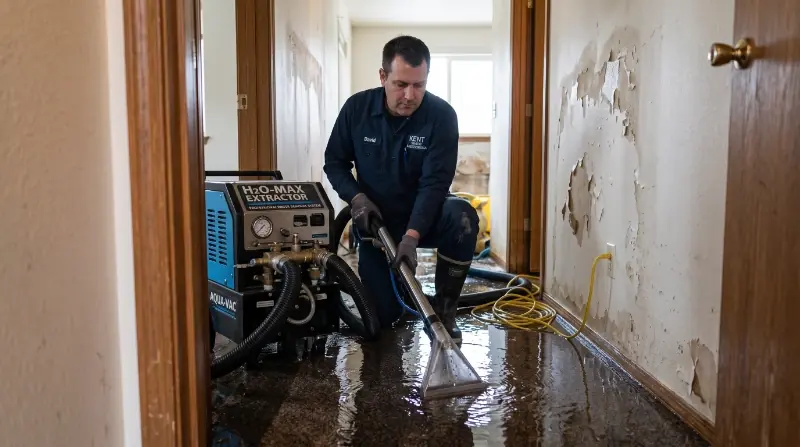
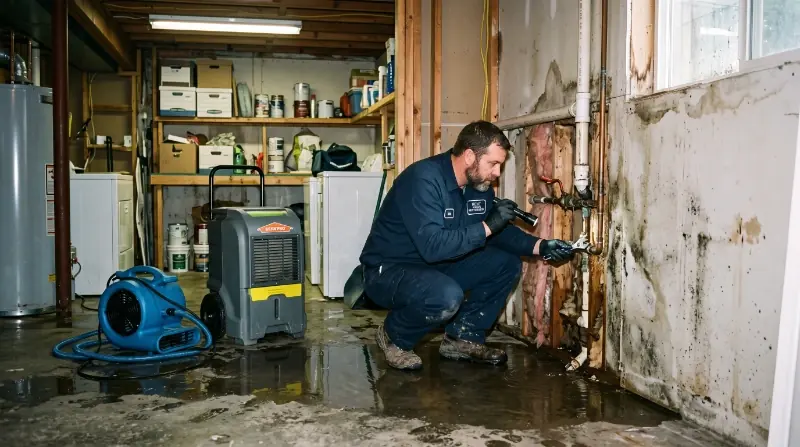

A consumer shop vac or wet-dry vacuum removes surface water. It cannot extract moisture from inside carpet backing, from under hardwood flooring, from subfloor assemblies, or from wall cavities. These are exactly the locations where water goes after a burst pipe — and where it stays, invisible and wet, until mold develops.
Kent homes built between 1970 and 1985, which represent the majority of the city's housing stock, have denser wood framing, thicker insulation batts, and heavier subfloor assemblies than modern construction. These materials hold moisture longer and require more aggressive extraction to reach the levels needed for successful drying. The EPA guidance on indoor mold and moisture states that mold can begin growing within 24 to 48 hours under favorable conditions — conditions that Kent's Pacific Northwest climate provides year-round.
Crawlspace Extraction
Kent Valley homes in 98032 and hillside homes in 98031 with crawlspace foundations face a specific extraction challenge. Crawlspace access is limited, and the standing water inside a crawlspace cannot be reached by standard truck-mounted equipment alone. Contractors in our network bring submersible pumps and portable extraction units sized for confined-space crawlspace access on every emergency dispatch to Kent Valley addresses.
The Green River Valley's high water table means crawlspaces in 98032 already run damp during the wet season. Any burst pipe that introduces additional water into a crawlspace that is already near saturation escalates quickly. Call immediately if your crawlspace has taken on water from any source.
What Happens After Extraction
Extraction removes standing water. It does not dry the structure. After extraction, commercial LGR dehumidifiers and high-velocity air movers run continuously for 3 to 5 days, drawing residual moisture from materials and maintaining the psychrometric conditions needed for progressive drying. The crew monitors moisture readings daily and documents every reading for your insurance adjuster. See our full restoration process page for the complete sequence.
Water Extraction Questions
Related Kent burst pipe pages
Need Water Extraction in Kent Right Now?
We roll immediately. All Kent ZIP codes. 24/7.
(831) 230-1431 — Call NowWhy does extraction speed determine your total loss?
A burst supply line in a Kent home releases 4 to 8 gallons per minute at typical residential water pressure. Six hours unattended — a workday, a school run, a single night — is 1,440 to 2,880 gallons. Water at that volume does not stay in the room where the pipe failed. It migrates through subfloor seams, follows framing members into adjacent walls, wicks into insulation from below, and runs under baseboards into connecting rooms. Thermal imaging on arrival routinely finds moisture 8 to 14 feet from the visible failure point.
The critical fact about water damage is that extraction speed directly determines how much material can be saved versus demolished. Drywall saturated for less than 24 hours can usually be dried in place. Drywall saturated for 48 to 72 hours has begun to lose structural integrity and is usually demolished and replaced. Hardwood flooring saturated for under 24 hours can often be dried in place with sub-floor drying mats. The same floor saturated for 72 hours is typically cupped beyond recovery. Every hour of delay converts a drying job into a demolition and rebuild job.
Truck-Mounted Extraction vs. Portable Units
Consumer wet-dry vacuums and portable extractors move surface water but cannot create the suction lift needed to pull absorbed moisture from carpet padding, subfloor, and the lower courses of drywall. The primary extraction unit is a truck-mounted system with a 200-CFM vacuum, which generates roughly 10 to 15 times the suction of portable extractors. For standing water removal in a flooded room, this translates to extraction rates of 50 to 150 gallons per hour depending on the depth and surface area.
For crawlspace flooding — common in Kent Valley ZIP 98032 where the Green River floodplain keeps the water table high — crews deploy submersible pumps rated at 1,800 gallons per hour before truck-mounted extraction. A crawlspace under 1,500 square feet with 2 inches of standing water can be pumped clear in under 30 minutes. Extraction then continues with truck-mount and portable units to remove absorbed moisture from the crawlspace soil and subfloor above.
How Water Category Is Assessed on Arrival
IICRC S500 classifies water losses into three categories based on the contamination level of the water source. This classification determines which materials can be dried in place versus which must be demolished, and it affects your insurance scope.
Category 1 (Clean water) — Water from a supply line, water heater, or toilet tank. No significant contaminants. Materials can generally be dried in place if reached within the time thresholds. Most burst pipe losses in Kent start as Category 1.
Category 2 (Gray water) — Water from a dishwasher, washing machine drain, or toilet bowl overflow. Contains biological or chemical contaminants. Some materials must be demolished even if structurally intact.
Category 3 (Black water) — Sewage backup or floodwater. Heavily contaminated. Most affected materials must be demolished. Not applicable to supply line bursts but relevant if a drain line was involved in the failure.
Category 1 water degrades over time — a supply line burst that has been standing for 72 hours in contact with building materials begins to take on Category 2 contamination characteristics. This is another reason rapid response matters: a job that arrives as Category 1 and stays Category 1 is significantly cheaper to remediate than one that arrives as Category 1 but has degraded to Category 2 by the time a crew shows up.
What equipment does a Kent water extraction job need?
Truck-Mounted Extractor
200-CFM truck-mount generating 10–15x the suction of portable units. Removes standing water and absorbed surface moisture from carpet, padding, and drywall base at 50–150 gallons/hour.
Submersible Crawlspace Pumps
1,800 gallon/hour submersible pumps for crawlspace flooding. Essential for Kent Valley (98032) homes where the Green River floodplain raises water intrusion volume rapidly.
Wand Extraction Tools
Specialized carpet and hard-floor wands for detail extraction. Hard-surface wands work concrete, tile, and hardwood. Carpet wands with weighted heads extract from padding.
Moisture Meters + Thermal Camera
FLIR thermal imaging locates hidden moisture migration before walls are opened. Penetrating meters confirm actual water content in framing and drywall to determine extraction scope.
Water extraction questions
What related services and pages should I look at?
Burst Pipe in Kent Right Now?
Your call routes directly to a licensed local contractor. On-site in 60 minutes across all Kent ZIP codes.
(831) 230-14311819 Central Ave S, Kent, WA 98032 · Serving 98030 · 98031 · 98032 · 98042 · Work performed by licensed, insured, IICRC-certified contractors