The King County Burst Pipe Guide: Pipes, Water, Weather, Law and Cost
Published October 19, 2026 · Updated October 2026 · 12 min read · By the WA Restore Pro editorial team
What your house is plumbed with, what your utility's water does to it, how cold it really gets here, and what Washington law says when the pipe finally lets go. One reference for the whole county.
Burst pipe in King County? Shut off the main, then call. Your call routes to a licensed local restoration contractor.
This King County burst pipe guide gathers the local facts that decide how a pipe fails and who pays: which pipe materials each construction era used, how soft Seattle-system water compares with the county's well and spring utilities, what the 2019, 2021 and 2024 cold snaps actually recorded, how insurers split burst pipes from floods, the WAC claim rules revised October 18, 2026, landlord repair deadlines, and typical repair costs. If water is running now, shut the main and call (831) 230-1431.
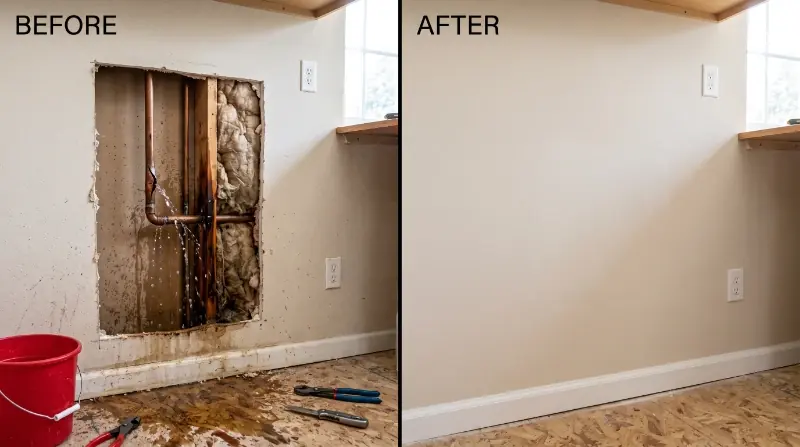
Who is this guide for, and how should you use it?
It is for King County homeowners, renters, landlords and property managers who want the background before a pipe fails, or who are sorting out a claim after one did. Each section stands alone, so skip to what you need.
This King County burst pipe guide is deliberately different from our service pages. Those pages tell you who to call in a given city. This one explains why pipes fail where they do, using construction records, utility test results, weather station readings and the actual text of Washington rules. Where a fact is local, we name the city or utility. Where something is general plumbing knowledge rather than a measured local fact, we say so.
Water on the floor as you read this? Stop here. Close the main shutoff, turn off breakers to wet rooms, and call (831) 230-1431 so we can route a licensed restoration contractor to you. Everything below will still be here tomorrow.
Which pipe materials are in a King County house, by decade?
The decade a house was built is the best single predictor of its original supply pipe. Remodels change the picture, but most homes still carry at least some original plumbing.
| Built | Typical original supply pipe | How it usually fails | King County examples |
|---|---|---|---|
| Before 1950 | Galvanized steel; some early copper | Rusts from inside, thins at threaded joints, splits when frozen | Enumclaw (12.7% pre-1940), Black Diamond mining cabins, Renton Highlands war housing |
| 1950s–1960s | Galvanized steel or copper with tin-lead solder | Joint leaks, pinholes, low pressure from scale and rust | Shoreline (median 1969), Burien (two-thirds 1969 or older), SeaTac |
| 1970s–mid-1980s | Copper; polybutylene begins appearing | Pinholes in copper; fitting failures in polybutylene | Covington's Timberlane plats, the Fairwood area near Renton |
| Mid-1980s–1990s | Copper with lead-free solder, polybutylene, early CPVC | Brittle CPVC cracks, polybutylene fittings, failed water heaters | Kenmore (median 1985), Bothell (median 1992), Covington (median 1994) |
| 2000s onward | PEX with crimp or expansion fittings; CPVC | Fitting and connector failures; appliance lines and hoses | Maple Valley (median 2001), Black Diamond's Ten Trails |
A few notes on the table. The median build years come from American Community Survey estimates compiled for each city, and the Covington figure that 98.55% of homes postdate 1960 comes from King County's 2023 historic context study. The pipe types are typical for each era across the Northwest, not an inventory of any specific street. Tin-lead solder was outlawed in Seattle in 1980 and nationally in 1986, which is why copper systems from before then are treated differently by utilities.
Newer does not mean immune. Black Diamond's housing went from 4,697 residents in 2020 to an estimated 6,978 in 2025, and 23.2% of its homes were built in 2020 or later. Those homes are full of PEX, which handles freezing better than rigid pipe, but they still have washer hoses, ice maker lines and water heater connectors, the parts behind a large share of indoor water losses. To check your own pipes, our page on how to identify the pipes in your home has a simple scratch test.
How does tap water chemistry differ across King County utilities?
Water in King County ranges from very soft mountain surface water to moderately hard well water, depending on your utility. Chemistry does not burst pipes, but it shapes how metal plumbing corrodes over decades.
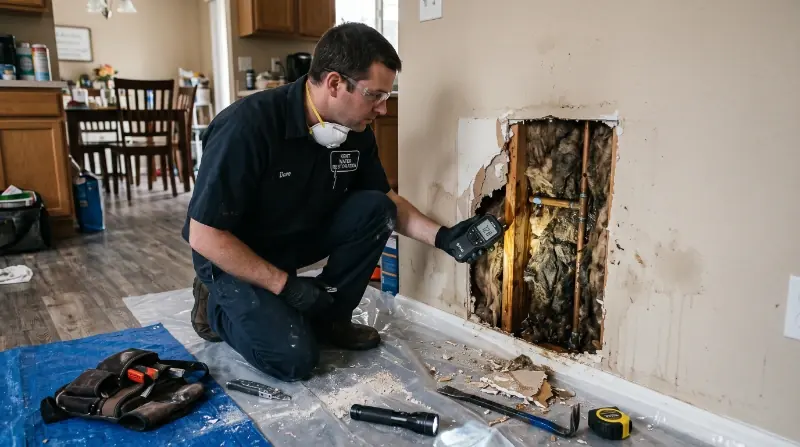
Seattle's Cedar and Tolt supply
Seattle Public Utilities draws from two protected watersheds, the Cedar River and the South Fork Tolt River, and sells water wholesale to many suburban districts. Quarterly SPU analysis from May 2026 put Cedar water at about 1.6–1.7 grains per gallon of hardness and Tolt water at roughly 0.5–1.5. That is very soft. SPU adds lime at the Cedar and lime with carbon dioxide at the Tolt, targeting a pH near 8.2, because rain and snowmelt that low in minerals can attack plumbing materials. Utilities on this supply include North City Water District in Shoreline, Northshore Utility District in Kenmore, the City of Bothell (on the Tolt pipeline since 1963), Highline Water District, Water Districts 20 and 125, Soos Creek Water & Sewer District, and Tukwila through the Cascade Water Alliance.
Groundwater and spring systems
Several cities run their own sources. Renton pumps mostly from downtown wells in the Cedar Valley Aquifer, with hardness around 44–48 mg/L, plus the Maplewood wellfield at about 69 mg/L and Springbrook Springs at about 125 mg/L, which is considered hard. Renton's treatment uses sodium hydroxide to lift pH, and orthophosphate is fed into the West Hill system to protect old cast-iron mains. Auburn relies on deep wells and springs, including West Hill Springs, bought in 1907, and Coal Creek Springs, developed in 1925, and built treatment to adjust pH and reduce copper leaching. Enumclaw's utility draws from Boise Springs and five other groundwater sources spread across four sites east of the city, and raises pH at two of them to reduce corrosion. Black Diamond's city system is groundwater. Lakehaven, serving the Federal Way area, operates 22 wells and is a partner in Tacoma's regional supply.
Tacoma's Green River supply
Covington Water District gets most of its water from Tacoma Public Utilities. Covington, Kent, Lakehaven and Tacoma formed the Regional Water Supply System in 2002, with Green River watershed water delivered by way of Tacoma's Second Supply Project.
What this means in practice: soft, aggressive water acting on 1960s copper is a plausible reason for the pinhole leaks plumbers find in older north-end and Highline homes. Harder well water tends to leave scale instead, which narrows galvanized pipe and reduces pressure. Neither replaces freezing and pressure as the cause of an actual burst. The copper pipe failure page covers pinholes in more depth.
What do King County's recorded cold snaps tell you about freeze risk?
Major pipe-freezing events here come every few years, not every winter, and that is part of the danger. Homeowners stop preparing, and then a week of teens catches thousands of unprotected pipes at once.
| Event | What was recorded | What happened to pipes |
|---|---|---|
| February 2019 | Sea-Tac's snowiest February on record at 20.2 inches; 20°F lows on February 5 and 6; third-coldest February on record | Weeks of snow cover and repeated nights below freezing |
| December 2021 | 17°F at Sea-Tac on December 27, a daily record and the coldest reading since November 2010 | A hard freeze over the holiday week, with about 5 inches of snow regionally |
| January 2024 | 15°F at Sea-Tac on January 13; local coverage called it the coldest in 33 years | About 175 Seattle Fire burst-pipe calls Jan 12–16; Sea-Tac baggage claim flooded; Kentwood Apartments residents in Kent without water for more than 24 hours; 312 water-line breaks recorded by Eastside Fire & Rescue within 12 hours |
For context, Seattle's only recorded 0°F reading was January 31, 1950. Those airport numbers also understate the cold in higher parts of the county. Elevations range from 39 feet in Kenmore to 745 feet in Enumclaw, which averages roughly 5°F colder than Seattle through the winter and gets strong east winds through the Cascade passes. Wind matters as much as temperature because it pulls heat out of crawlspaces and exterior walls faster.
Across every city, the first pipes to freeze are predictable: outdoor faucets lacking a frost-free sillcock, supply lines along vented crawlspace walls, pipes in exterior kitchen walls, lines in unheated garages, and manufactured home underbellies with failed heat tape. When a hard freeze is forecast, disconnect hoses, close foundation vents, open cabinet doors on outside walls, don't let the thermostat drop below 55°F, and let the faucet farthest from the main drip. Our frozen pipe burst page explains how to thaw a pipe without a torch.
Burst pipe or flood: how do insurers tell them apart?
Insurers ask where the water came from. Water released suddenly from your plumbing is usually covered under a standard homeowners policy. Water that came from outside, such as a river, creek, storm runoff or rising groundwater, is usually excluded and needs flood insurance.
Some situations get their own local guide. Owners in Des Moines and other condo buildings can see how master policies and HO-6 coverage split a unit-to-unit leak in the Des Moines condo burst pipe guide, and business owners in the Green River valley can follow the commercial burst pipe playbook for Tukwila for business interruption claims and sprinkler line breaks.
December 2025 made that line very real in King County. A series of atmospheric rivers began on December 8. The Cedar River at Renton set a new USGS peak of 18.25 feet on December 11, breaking the November 1990 record of 17.13 feet. On December 15, the Desimone Levee on the Green River in Tukwila breached and more than 500 people were evacuated from parts of Kent, Renton and Tukwila. Levees on the Green and White rivers failed on back-to-back days and the town of Pacific flooded. The federal major disaster declaration that followed, DR-4906-WA, covers December 5–19, 2025. None of that river water was a burst pipe claim, and households without NFIP or private flood policies leaned on federal assistance instead.
The gray areas cause most disputes:
- Gradual leaks. A drip under a sink that rotted the cabinet floor over months is usually excluded as wear and tear or long-term seepage. The sudden failure of the same line is usually covered.
- Vacant homes. If you left the house unheated, or didn't shut off and drain the water, a lot of policies won't pay for freeze damage. Read the vacancy clause before you leave for a long trip.
- Sewer backup. Often excluded unless you bought a water backup endorsement.
- Mold. Frequently subject to a sublimit, which is one more reason fast drying matters. EPA guidance says mold can begin growing within 24 to 48 hours.
- Tear-out to reach the pipe. Many policies cover the cost to access and repair the damage even when the failed pipe itself is not covered.
Ask your restoration contractor to record the source, the water category and photos of the failed part. Keep that part. Insurers sometimes send an investigator to examine it.
What does Washington law say about claim timelines after October 18, 2026?
Washington revised its unfair claims settlement rules effective October 18, 2026 (WSR 26-17-089). The biggest change is when the clock starts on an insurer's decision to accept or deny your claim.
Under the current WAC 284-30-380, an insurer must accept or deny a first-party claim within 30 calendar days after notification of claim. If it needs more time, it must notify you within those 30 days and update you every 30 calendar days. Under the prior rule, in effect until October 17, 2026, the insurer had 15 working days after receiving completed proofs of loss, with a 45-day follow-up and then 30-day updates. Neither version sets a deadline for payment itself.
Two related rules frame the process. WAC 284-30-360 requires the insurer to acknowledge your claim within 10 business days on an individual policy, or 15 on a group policy; before October 18, 2026, the rule said "working days." WAC 284-30-370 requires the insurer to finish its investigation within 30 calendar days after notification unless it cannot reasonably be completed in that time. If a carrier misses these timelines or you think the handling is unfair, you can file a complaint with the Washington Office of the Insurance Commissioner.
Practical tip: report the loss to your insurer the day it happens, in writing as well as by phone, and note the date. Under the current rule, notification is what starts the 30-day decision clock.
Renters and landlords: how fast must repairs start?
RCW 59.18.070 sets how quickly a landlord must begin repairs after a tenant gives notice, and the deadline depends on how serious the problem is. RCW 59.18.060 sets the underlying duties.
| Condition after a burst pipe | Landlord must begin repairs within |
|---|---|
| Unit has lost hot or cold water, heat or power, or something poses an imminent danger to life | 24 hours |
| A landlord-supplied fridge, stove and oven, or major plumbing fixture can't be used | 72 hours |
| All other defects | 10 days |
The statute allows an exception where circumstances are beyond the landlord's control, such as a citywide freeze that books every plumber for days. Under RCW 59.18.060, the landlord must keep the premises fit to live in, maintain plumbing and heating, keep the unit reasonably weathertight, and provide adequate heat, water and hot water. This matters county-wide because about 44.6% of King County households rent. Read the statute before quoting its notice wording; our landlord page walks through the first 24 hours.
How do you vet a restoration contractor in King County?
Check the license first, then the process. A good contractor will show you its registration, explain the water category, and share daily moisture readings without being asked twice.
- Look up the L&I registration. Washington's verify tool at secure.lni.wa.gov/verify shows whether a contractor is registered, bonded and insured, and lists any infractions. Every contractor we route to provides this number before starting work.
- Ask about IICRC certification. The IICRC S500 standard governs water damage restoration, and S520 covers mold. Certified technicians should be able to explain Category 1, 2 and 3 water and Class 1 to 4 drying loads in plain language.
- Insist on documentation. Expect a moisture map, a daily drying log with relative humidity and material readings, photos, and an itemized estimate, often written in Xactimate, the software most insurers use.
- Refuse to close wet walls. Drywall and flooring should go back only when readings match a dry reference area. Covering a wet cavity is the classic route to hidden mold.
- Know who pulls permits. Repiping and rebuild work may need a permit. Cities issue their own; for unincorporated addresses, the King County Permitting Division handles it. Renton, for instance, won't let renovation or demolition proceed without an asbestos survey, a real consideration for pre-1980 tear-out.
- Read before you sign. Be cautious of pressure to sign an assignment of benefits on the spot, cash-only terms, or estimates that will not itemize labor and equipment.
What does a burst pipe cost to repair and restore in King County?
Costs depend on how long water ran, what it soaked and what it was made of. These ranges cover most residential jobs; your actual estimate will vary.
| Work | Typical range | What moves the price |
|---|---|---|
| Plumber: simple pipe section repair | $150–$600 | Access (open crawlspace vs finished wall), material, after-hours call |
| Plumber: whole-home repipe | $4,000–$15,000+ | House size, number of fixtures, PEX vs copper, wall patching |
| Minor restoration: one room, extraction and drying | $1,500–$4,000 | Carpet vs hardwood, water category, days of equipment |
| Moderate restoration: several rooms with drywall removal | $5,000–$15,000 | Square footage of flood cuts, insulation, cabinets |
| Major restoration: subfloor, cabinets, multiple floors | $15,000–$35,000+ | Structural repairs, ceiling collapse, contents, asbestos abatement |
| Your share on a covered claim | Deductible, commonly $1,000–$2,500 | Policy terms, mold sublimits, exclusions |
For an estimate built around your rooms and materials, use the restoration cost estimator. If you are deciding between patching and replacing old pipe, the repair versus repipe page lays out the tradeoffs.
A five-minute checklist to keep by the main shutoff
This is the part of the King County burst pipe guide worth printing. Tape this list inside the cabinet or crawlspace hatch nearest your main valve, so anyone in the house can act without searching for it.
- Main shutoff location, and whether it is a gate valve (turn clockwise until it stops) or a quarter-turn ball valve.
- Your water utility's name from the bill, for meter shutoff if the house valve fails.
- Breaker labels for rooms with plumbing.
- Insurance policy number, deductible and whether you have water backup and flood coverage.
- Landlord or HOA contact if you rent or own a condo.
- Our number, (831) 230-1431, for routing a restoration crew anywhere in the cities listed on the King County service area page, including burst pipe restoration in Kent, WA.
Every city in our network has its own page with local housing, utility and weather detail. Start with Renton, Shoreline or Enumclaw if you want to see how much the risks change from one end of the county to the other.
King County burst pipe guide: common questions
Is King County water soft enough to damage copper pipes?
Seattle-system water, which many King County districts buy, is very soft, roughly 0.5 to 1.7 grains per gallon, and the utility doses it with lime for that reason, since water this soft can corrode plumbing. Over decades, that can contribute to pinhole leaks in older copper. It does not cause sudden bursts, which come from freezing or pressure. Well-supplied cities like Renton and Auburn have harder water and adjust pH too.
Did the October 18, 2026 rule change shorten the time my insurer has to decide?
It changed when the clock starts. Under the revised WAC 284-30-380, the insurer now has 30 calendar days after notification of claim to accept or deny, with updates every 30 days if it needs longer. The old rule counted 15 working days from receipt of completed proofs of loss. Neither version sets a payment deadline. Report your loss in writing the same day.
What temperature should worry me about pipes freezing in King County?
There is no single number, because wind, insulation and how long the cold lasts all matter. Trouble rises sharply when lows sit in the teens or low 20s for several nights, as in December 2021 at 17°F and January 2024 at 15°F at Sea-Tac. Higher areas such as Enumclaw run colder than the airport, so prepare earlier there.
How do I check a restoration contractor's Washington license?
Use the Department of Labor and Industries verify tool at secure.lni.wa.gov/verify. Search by business name or registration number to see whether the contractor is registered, bonded and insured, and whether it has any infractions. Every contractor in our network gives you its registration number before starting work, so you can check it yourself first.
My landlord says a citywide freeze means repairs can wait. Is that allowed?
Sometimes. RCW 59.18.070 requires repairs to begin within 24 hours when you lack water or heat, but it makes an exception for circumstances beyond the landlord's control. A regional freeze that books every plumber may qualify for a short delay. The landlord should still act as soon as help is available and keep you informed. Document your notice and every response in writing.
Which King County homes are most likely to still have galvanized pipe?
Homes built before about 1960 that have never been fully repiped. That includes much of Shoreline, where the median house dates to 1969 and 22.9% were built in the 1950s, older Burien and SeaTac neighborhoods, Renton's wartime Highlands housing, and pre-1940 homes in Enumclaw and Black Diamond. A magnet sticks to galvanized steel but not to copper.
Related Pages
Water Coming Through in King County Right Now?
Call (831) 230-143124 hours a day · Licensed, insured, IICRC-certified contractors · Insurance documentation from the first visit