Condo Burst Pipe Des Moines WA Owners Face: Who Pays, Who Dries It
Published October 19, 2026 · Updated October 2026 · 11 min read · By the WA Restore Pro editorial team
When a pipe fails in a Des Moines condo, water crosses unit lines and two insurance policies get involved. Here is how the master policy, your HO-6 and Washington condo law sort it out.
Burst pipe in Des Moines? Shut off the main, then call. Your call routes to a licensed local restoration contractor.
A condo burst pipe Des Moines WA owners deal with is rarely one person's problem. Water crosses into the unit below, the HOA's master policy and your HO-6 policy each cover different pieces, and the building's declaration decides who owns which pipe. First, close your unit valve and tell the manager. Then call (831) 230-1431 so a licensed, IICRC-certified restoration contractor can start drying and documenting every affected unit. This guide explains who pays, which Washington condo law applies, and how to protect a waterfront or seasonal unit.

Who pays when a condo pipe bursts in Des Moines?
It depends on three things: where the pipe sits, what the condo declaration says, and what caused the failure. Common pipes are usually the association's responsibility; fixtures and lines serving only your unit are usually yours.
Plenty of Des Moines buildings raise this question, and a condo burst pipe Des Moines WA owners report usually involves at least two units. The city's 2022 Housing Needs Assessment found 4,418 homes sitting in structures with five or more units, and about two-thirds of everything permitted from 1980 through 2021 was multifamily. Many of those are condos near the Marina, on the bluffs above Redondo and Zenith, and along Pacific Highway South.
A rough rule that holds in many Washington declarations:
- Usually the association: main risers, shared drain stacks, pipes inside common walls that serve more than one unit, and building structure such as framing and exterior walls.
- Usually the unit owner: the water heater, toilet supply lines, dishwasher and washer hoses, fixtures, angle stops and branch lines past your unit shutoff, plus your finishes and belongings.
- Often disputed: drywall and flooring inside your unit, cabinets, and pipes inside a wall between your unit and a hallway.
Cause can change the answer. Many declarations let the association pass costs to the owner whose negligence caused a loss, for example a washer hose that was visibly cracked or a heater shut off in a vacant unit during a freeze. Read the maintenance and insurance sections of your declaration before you need them. Your manager can send a copy.
Which Washington condo law applies to your building?
It depends on when the condo was created. Washington has three statutes, and your declaration will say which one the building was formed under.
| Law | Generally applies to | What it means for leaks |
|---|---|---|
| Horizontal Property Regimes Act, chapter 64.32 RCW | Older condominiums created before the 1990 Condominium Act took effect | The declaration and bylaws carry most of the weight on repair and insurance duties |
| Washington Condominium Act, chapter 64.34 RCW | Condominiums created on or after July 1, 1990 | Sets baseline rules for association insurance and maintenance; the declaration fills in details |
| Washington Uniform Common Interest Ownership Act (WUCIOA), chapter 64.90 RCW | Common interest communities created on or after July 1, 2018, plus older communities that opt in | The current framework for new associations, including insurance requirements |
With 78% of Des Moines housing built between 1950 and 1980, plenty of local condo buildings were either built as condos under the older act or converted from apartments later, which can put them under a newer statute. That is why the declaration matters more than any rule of thumb. Nothing here is legal advice. If you end up in a dispute with an association, a Washington attorney who handles community association law can read your documents. For problems with an insurer, the Washington Office of the Insurance Commissioner takes consumer complaints.
The first 30 minutes in a stacked building
Stop the water at the closest valve, warn the people below you, and reach the building manager. Everything else, including the claim, can wait a half hour.
Close your unit shutoff
In many Des Moines condos it sits in the water heater closet, under the kitchen sink, or behind an access panel near the bathroom. If you cannot find one, close the angle stop at the failed fixture and call the manager to shut the riser.
Knock on the unit below
Water from a second-floor kitchen can be dripping through a first-floor light fixture within minutes. Your neighbor needs to cut power to that room and move valuables.
Call the HOA or manager's emergency line
They may need to shut a riser, open a locked mechanical room, or alert the master policy carrier. Ask whether the association already uses a preferred restoration vendor.
Photograph before cleanup
Shoot the source, the water path and every damaged surface in both units. Keep the failed hose or fitting; investigators sometimes ask for it.
Get drying started
Call (831) 230-1431. The restoration contractor can begin extraction and set equipment while the insurers sort out who pays, which protects everyone's position.
Do not wait for the insurers to agree before drying starts. Per EPA guidance, damp building materials can grow mold in 24 to 48 hours, and most policies expect you to take reasonable steps to prevent further damage.
How does water travel from unit to unit?
Down and sideways, following framing, plumbing chases and light fixtures. In wood-frame buildings it can cross several floors, so every unit below the source needs its own moisture check.
Some Des Moines condos are older garden-style buildings with wood framing and drywall ceilings. Since 2007, the city has also allowed five-story wood-frame buildings in the Pacific Ridge zone along Pacific Highway South. Either way, water from an upper-floor failure tends to show up as:
- a ceiling stain or sagging drywall directly below the source,
- water running out of recessed lights or smoke detectors,
- swollen baseboards in the unit next door if the leak sat inside a shared wall,
- wet carpet along a wall in a unit two floors down, with nothing visible on the floor between.
A thermal imaging camera and a pinless moisture meter let the crew trace that path without opening walls blindly. Each unit should get its own moisture map and drying log. When one contractor handles the whole building, the paperwork stays consistent and the adjusters get a single story. When each owner hires separately, gaps appear, and someone's wall cavity gets missed.
Clean water does not always stay clean
Supply-line water starts as Category 1. If it sits in carpet pad and subfloor for a couple of days, or picks up contamination as it moves, it can degrade to Category 2. A leak from a shared drain stack or a toilet overflow with waste is Category 3 from the start. That classification changes how much material comes out and whether antimicrobial treatment is needed, and the contractor should explain the call to every owner affected.
HOA master policy versus HO-6: what each one covers
The master policy covers the building and common elements; your HO-6 covers your unit's interior, upgrades, belongings, liability and often your share of the master deductible.
| Item | HOA master policy | Unit owner HO-6 |
|---|---|---|
| Building structure, roof, exterior walls | Yes | No |
| Common risers and shared pipes | Usually | No |
| Interior drywall, flooring and cabinets | Depends on policy type ("bare walls" vs "all-in") | Covers what the master excludes |
| Upgrades you added (new floors, custom kitchen) | Often not | Yes, if limits are high enough |
| Furniture, clothing, electronics | No | Yes (personal property) |
| Hotel or rental while the unit dries | No | Additional living expense (ALE) |
| Damage you cause to a neighbor's unit | Sometimes, through the master | Personal liability |
| Your share of the master deductible | N/A | Loss assessment coverage, if you have it |
Renters in condo units need their own HO-4 renters policy for belongings and liability. The unit owner who rents the unit out should carry a landlord form of HO-6. Our Renton guide to condo master policies and HO-6 claims walks through a claim from the insurer's side; this section is about who owns what inside a Des Moines building.
Why the master deductible can hit you hardest
Master policy deductibles are often far larger than the $1,000 to $2,500 typical on a house. Many associations bill some or all of it back to the owner whose unit the water came from.
If your declaration allows that, a cracked toilet supply line in your bathroom could leave you owing the full master deductible even though the association's policy pays for the building repairs. Loss assessment coverage on an HO-6 policy is designed for that situation, but limits vary widely and some policies cap the amount for deductible assessments. Ask your agent two specific questions: what is our association's current master deductible for water damage, and does my loss assessment limit cover it? Check again each year, because master deductibles can rise at renewal.
Restoration costs themselves follow the same ranges as any home: a one-room job typically lands near $1,500–$4,000, $5,000 to $15,000 for several rooms with drywall removal, and $15,000 to $35,000 or more when a leak spreads across floors. A two-unit or three-unit condo loss can reach that top range quickly because each unit has its own ceiling, flooring and cabinets. Final numbers depend on what the moisture map shows, and emergency rates may be added after hours.
Waterfront and seasonal units: the empty-home problem
An empty unit is the riskiest kind in winter. Without heat or a neighbor checking in, a broken line can run for days, and many policies limit freeze coverage when the heat was off and the water was left on.
Some Des Moines owners use waterfront condos and Redondo or Zenith homes part-time, travel for long stretches, or keep a unit empty between tenants. The cold snaps that cause trouble here are short and sharp. Winter 2024 brought back-to-back mornings near 15°F at Sea-Tac, a short drive from downtown Des Moines, and December 2021 bottomed out at 17°F. A unit with the thermostat turned way down and a supply line in an exterior wall facing the water can freeze on nights like those.
Prep list for a winter trip
- Keep the heat on at a steady temperature your policy considers adequate. Many policies and leases use 50 to 55°F as a working minimum; check yours.
- Close your unit shutoff, and open a faucet briefly to relieve pressure. Leave the water heater on vacation mode if your building allows it.
- Install a leak sensor under the water heater and kitchen sink, and consider an automatic shutoff valve that closes the line if it detects water.
- Give the manager or a trusted neighbor a key and a phone number, and ask them to look in during freeze warnings.
- Read the vacancy and unoccupancy clauses. Some policies cut or exclude coverage after a set number of days empty.
King tides are a different risk
On December 27, 2022, a king tide crossed Redondo Beach Drive S, and one Redondo home had 3–4 inches of water through every room. Ground-floor condos and townhouses near the beach face the same exposure. Salt water from the Sound is flood, which standard condo and homeowner policies exclude. The association may or may not carry flood coverage on the building, and an HO-6 policy will not cover flood without a separate policy. Ask your manager whether the building has an NFIP or private flood policy, and buy unit flood coverage if you are on a low floor near the water.
What good condo water restoration in Des Moines looks like
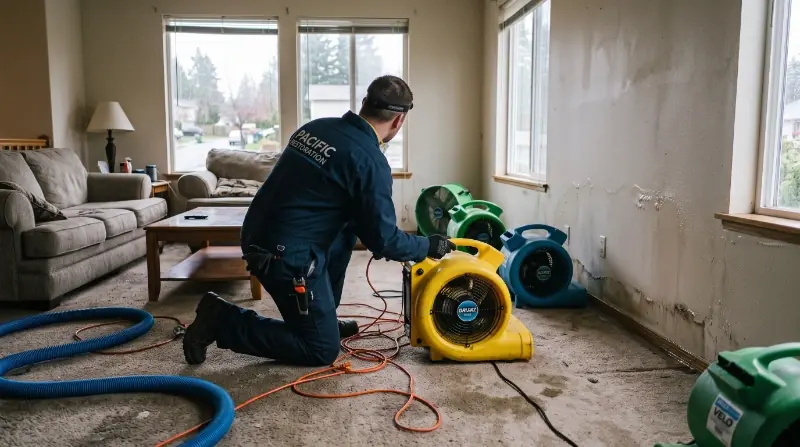
The crew dries every affected unit to a measured standard and shares the readings with each owner and the association. After any condo burst pipe Des Moines WA buildings go through, the estimate should be one both insurers can follow line by line.
- One moisture map per unit, with dated readings, so nobody's wall cavity gets skipped.
- Targeted demolition. Flood cuts only where meters show wet material; cabinet toe kicks removed or drilled so air can reach the space beneath; wall-cavity drying systems that push air into sealed walls without opening them.
- Right-sized equipment. Condo units are small and often shared-wall, so the crew balances air movers and LGR dehumidifiers to avoid tripping breakers or pushing humidity into the next unit.
- Antimicrobial where it belongs: on framing and subfloor touched by Category 2 or 3 water.
- Xactimate estimates broken out by unit and by insurer responsibility.
- A clear end point. The crew removes fans and dehumidifiers after wet areas test the same as dry reference spots.
For buildings near the airport, one more check helps. The Port of Seattle's sound insulation program has reached Des Moines condos, including the 28-unit Villa Enzian, and the Port's 2025 follow-up survey flagged moisture between panes, possible seal failure, and weep holes that had been caulked shut. Water at a window sill can look like a pipe leak inside the wall. A thermal camera sorts that out before anyone cuts drywall.
What if you rent a condo unit in Des Moines?
Report the leak to your landlord and the building manager right away, in writing. RCW 59.18.060, part of the state's landlord-tenant law, makes the landlord responsible for keeping plumbing fixtures working.
Under RCW 59.18.070, the clock starts when the landlord gets notice: 24 hours if you are without hot or cold water or face an imminent hazard to life, 72 hours if a landlord-supplied major plumbing fixture is out, and 10 days for most other defects. Your HO-4 renters policy covers your belongings and possibly a hotel stay; it does not cover the building. If water from your unit damaged a neighbor's unit, the liability portion of your renters policy may respond. More detail for property owners is on our landlord burst pipe page, and tenants in larger complexes can read the apartment burst pipe guide.
The Des Moines burst pipe restoration page covers houses and neighborhoods across the city, and our neighbors in Burien get the same service. For every city we serve, see the King County coverage page, or start at WA Restore Pro's home page. If water is crossing into another unit right now, call (831) 230-1431.
Condo water damage Des Moines owners ask about
Water from the unit above ruined my ceiling. Whose insurance pays?
Usually the master policy covers the building structure and your HO-6 covers interior finishes and belongings, but your declaration controls the split. If the upstairs owner was negligent, their liability coverage may also respond. Report it to the manager and your insurer the same day, and get the drying started instead of waiting for the insurers to agree.
Can my Des Moines HOA charge me the master policy deductible?
Many declarations allow it when the leak started in your unit or came from something you maintain, such as a water heater or appliance hose. Check the insurance section of your declaration. Loss assessment coverage on an HO-6 policy can pay that charge up to its limit, so compare your limit with the association's current water damage deductible.
Does it matter whether my building falls under RCW 64.34 or RCW 64.90?
It can, because each law sets different baseline rules for insurance and maintenance, but the declaration usually fills in the details that matter most in a leak. Buildings created on or after July 1, 1990 generally fall under the Condominium Act, and communities created on or after July 1, 2018 fall under WUCIOA. Your declaration names the governing statute.
I spend winters away from my Redondo condo. What protects it from a freeze?
Keep the heat on, close the unit shutoff, and give someone local a key. A leak sensor or automatic shutoff valve adds a second layer. Read your HO-6 for vacancy and freeze conditions, because many policies limit coverage when heat was not maintained. Ask the manager to check your unit during freeze warnings.
Should the HOA's restoration company also dry my unit?
Often that is the cleanest option, because one contractor documents the whole building the same way. You still have the right to see your unit's moisture readings, drying log and estimate. If you choose your own contractor, make sure they coordinate with the association's vendor so walls shared between units are dried on both sides.
Is a leak from a shared drain stack treated differently than a supply line break?
Yes. A drain stack leak with waste is Category 3 water, so carpet, pad and porous drywall it touched normally come out rather than being dried, and antimicrobial goes on the framing. The stack itself is usually a common element the association repairs, but damage inside your unit may still involve your HO-6.
Who fixes the pipe in a condo, the plumber or the restoration crew?
A licensed Washington plumber repairs the pipe. The restoration contractor removes the water, dries the building and documents the damage. For a common riser or stack, the association usually hires the plumber. For a line inside your unit, you usually do. Many restoration contractors in our network coordinate a plumber if you need one.
Related Pages
Water Coming Through in Des Moines Right Now?
Call (831) 230-143124 hours a day · Licensed, insured, IICRC-certified contractors · Insurance documentation from the first visit