Structural Drying After a Burst Pipe in Kent, WA
Last updated: October 2026
Commercial LGR dehumidifiers and high-velocity air movers running continuously to IICRC S500 standard. Dry means a calibrated meter reading, not a surface that feels dry.
Structural drying after a burst pipe in Kent, WA uses commercial LGR dehumidifiers and high-velocity air movers running continuously for 3 to 5 days following IICRC S500 psychrometric standards. Dry standard is not visual inspection or touch — it is a calibrated moisture meter reading at or below pre-loss baselines for all affected materials. We provide daily moisture logs with timestamps to your insurance adjuster and do not close walls until S500 dry standard is confirmed.
Why does structural drying take 3 to 5 days in Kent homes?
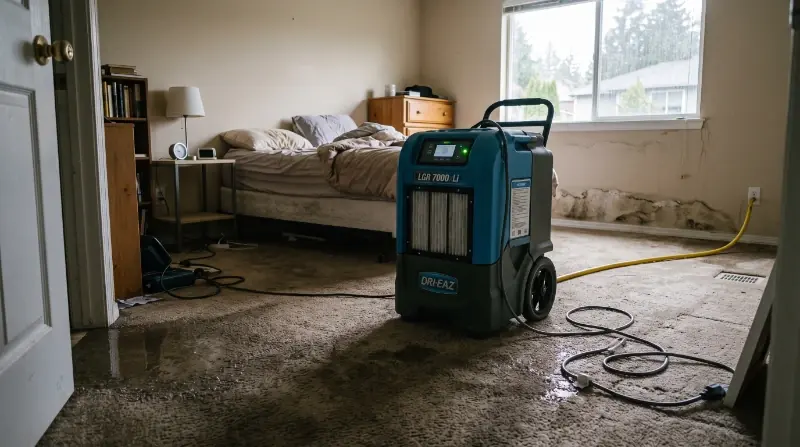
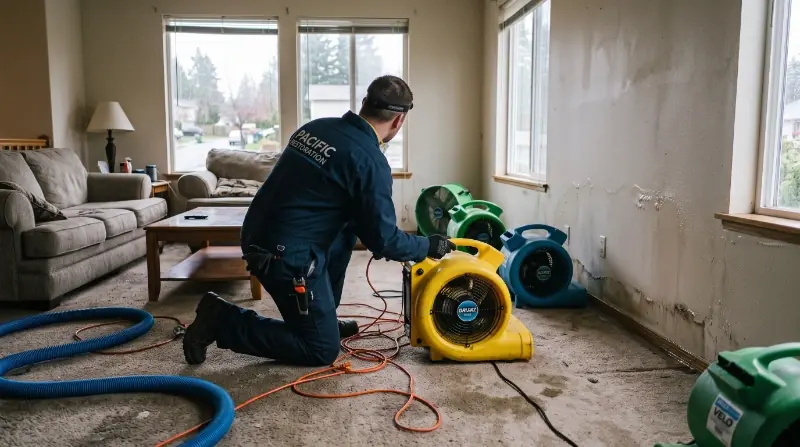
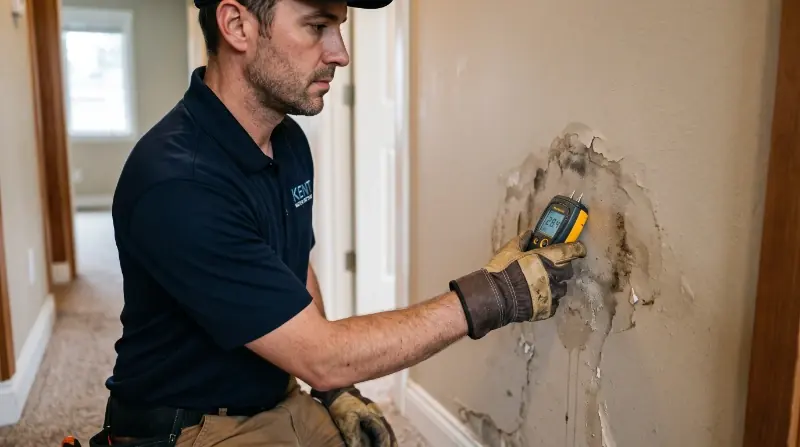
A wall that feels dry on the surface can hold 30 to 35 percent moisture content inside — more than enough to support mold growth. Consumer fans and dehumidifiers cannot extract moisture from inside wall cavities, subfloor assemblies, or dense insulation batts. Commercial equipment runs at a capacity that changes the physics of moisture movement in the structure.
Kent homes built between 1970 and 1985 have denser wood framing and heavier insulation than modern construction. These materials hold moisture longer and require more aggressive drying cycles. A 1978 East Hill ranch may take 5 to 6 days to reach dry standard while a 2010 Lake Meridian home might reach it in 3 days. We adjust equipment placement and check readings daily rather than running a fixed clock.
IICRC S500 Standards and Insurance Documentation
The IICRC S500 standard defines what properly documented drying looks like. Insurance carriers and their adjusters are trained to look for S500-compliant documentation. A carrier can and does question whether drying was complete if the restoration company cannot produce daily moisture logs showing progressive drying from wet to established dry standard. We produce that documentation on every job and include it in the insurance package alongside photographs and the Xactimate scope estimate.
Washington State law gives you the right to choose your own restoration contractor. Your carrier cannot require you to use their preferred vendor list, per the Washington State Office of the Insurance Commissioner. Our S500-compliant documentation protects your claim regardless of which carrier you are working with. See our full insurance guide for more on your rights.
Related Kent burst pipe pages
Need Structural Drying in Kent, WA?
Network contractors set up drying equipment the same day as extraction. All Kent ZIP codes. 24/7.
(831) 230-1431 — Call NowWhy 3 to 5 days and not 3 to 5 hours?
The most common mistake homeowners make after a burst pipe is assuming the damage is "dry" once the visible water is gone. A wet-dry vacuum or consumer fan moves surface moisture but does nothing for water absorbed into drywall, subfloor, wall framing, or insulation. These materials are porous and hold water in their cellular structure — not on their surface — and evaporation from inside those cells is slow without the right equipment and the right conditions.
IICRC S500 defines structural drying as a process, not a duration. The job is complete when calibrated moisture meter readings return to pre-loss baseline — a specific moisture content percentage determined by reference readings from unaffected materials in the same structure. In Kent, WA homes with wood framing and Pacific Northwest ambient humidity, that baseline is typically 12 to 16% wood moisture content. The drying equipment runs until measurements reach that number and hold there for 24 hours — regardless of whether that takes 3 days or 7.
What Happens When Drying Is Rushed or Incomplete
Closing walls before structural materials reach dry standard is the leading cause of post-restoration mold claims. Mold requires three things: a food source (wood, drywall paper), a temperature range (40°F to 100°F — standard indoor conditions), and moisture content above roughly 19% in wood. A wall that feels dry to the touch can still carry 22% moisture content inside the framing. Seal that wall and you have created the ideal mold incubator.
Insurance carriers are aware of this. Most major carriers will not cover a secondary mold claim caused by a contractor who closed walls before documented dry standard. Our daily moisture logs — timestamped, location-keyed, and formatted for Xactimate — give your adjuster the proof that the job was done to S500 standard and that no wall was closed prematurely.
The Kent, WA Climate Factor
Structural drying is harder in the Pacific Northwest than in dry climates. Kent averages 44 to 50 inches of rain annually, and ambient indoor relative humidity during the November-through-March wet season can run 55 to 70% without dehumidification. At that ambient humidity, evaporation from wet building materials slows dramatically — moisture moves from wet materials into the air, but if the air is already nearly saturated, there is nowhere for it to go.
LGR (Low Grain Refrigerant) dehumidifiers are the solution. Unlike consumer dehumidifiers rated at standard conditions, LGR units maintain high capacity at the low temperatures and high relative humidity typical of Kent homes in wet season. A DriEaz LGR 7000 removes 150 pints per day under real-world saturated conditions — roughly 20 times the output of a consumer unit. We deploy these at a ratio based on the cubic footage of the drying chamber, per IICRC S500 equipment placement guidelines.
What equipment is used for structural drying in Kent, WA?
Every structural drying job uses calibrated, commercial-grade equipment. Consumer rental equipment is not adequate for insurance-grade S500 drying and will not produce the moisture readings required by your adjuster.
LGR Dehumidifiers
DriEaz LGR 7000 series. 150 pints/day at real-world conditions. Continuous drainage via hose — no bucket emptying. Run 24 hours a day for the full drying cycle.
High-Velocity Air Movers
Dri-Eaz Velo Pro and Phoenix Axial units. Placed at the base of wet walls to create a vortex airflow pattern that pulls moisture out of the wall cavity from bottom to top. Quantity and placement calculated per S500.
Penetrating Moisture Meters
Delmhorst and Tramex professional meters. Measure moisture content inside materials, not just on the surface. Required for S500 documentation. Read multiple times daily, logged with timestamp and location.
Thermal Imaging Camera
FLIR thermal camera identifies cold wet areas behind walls and under floors before they are opened. Locates moisture migration paths that meter probing alone would miss. Used on arrival and at each daily check.
Psychrometer / Hygrometer
Measures ambient temperature and relative humidity inside the drying chamber. Used to calculate evaporation rate and adjust equipment placement. Required for S500 psychrometric drying plan.
Drying Logs
Every reading from every instrument at every location, timestamped, compiled daily. Formatted for Xactimate and delivered to your adjuster. The physical proof that drying met S500 standard.
What Does Structural Drying Cost in Kent, WA?
Structural drying costs depend on the size of the affected area, the number of materials affected (drywall only vs. drywall plus subfloor plus framing), and the duration of the drying cycle. A single-room drying job in Kent typically runs $800 to $2,500. Multi-room or crawlspace jobs run $2,000 to $6,000. These costs are covered by standard homeowner policies beyond your deductible.
We provide a written estimate before equipment is placed and do not change scope without your written approval. The estimate is formatted for direct submission to your carrier. If the scope changes during drying — which can happen when moisture mapping reveals additional migration — we notify you and your adjuster before proceeding.
Equipment rental from a home improvement store for a single dehumidifier runs $40 to $80 per day and will not produce S500-documentation or adequate drying capacity for a serious loss. In most cases, the insurance-covered cost of professional drying is far less than the out-of-pocket cost of secondary mold remediation caused by inadequate drying.
Structural drying questions
What related services and pages should I look at?
Burst Pipe in Kent Right Now?
Your call routes directly to a licensed local contractor. On-site in 60 minutes across all Kent ZIP codes.
(831) 230-14311819 Central Ave S, Kent, WA 98032 · Serving 98030 · 98031 · 98032 · 98042 · Work performed by licensed, insured, IICRC-certified contractors