Do I Have Galvanized Pipes? A Kent, WA Homeowner's Identification & Lifespan Guide
Last updated: October 2026
Kent homes built between 1930 and 1975 almost certainly have galvanized steel supply lines now 51 to 96 years old — all past rated service life. Galvanized pipes corrode from the inside out, gradually narrowing the water bore until they fail suddenly. When they fail, the burst is covered by standard homeowner insurance as a sudden and accidental loss. WA Restore Pro handles the water damage restoration while coordinating with licensed WA plumbers for the pipe repair or full repipe. Call (831) 230-1431 — 24/7 response across all Kent ZIP codes.
If your inspection confirms galvanized pipe, our Kent burst pipe restoration service can respond immediately when a section fails.
What are galvanized pipes and why are they in so many Kent homes?
Galvanized steel pipe was the residential plumbing standard in the United States from the 1930s through the mid-1970s. The pipe is made from steel coated in a layer of zinc — galvanization — intended to prevent the steel underneath from rusting. In Kent, WA, where the bulk of the residential housing stock was built between 1945 and 1985, galvanized supply lines are common in any home predating approximately 1975.
The zinc coating works for a period — typically 20 to 30 years in residential service. After the zinc layer has thinned and worn away, the steel underneath begins to oxidize. Unlike surface rust, galvanized pipe corrosion happens primarily on the interior of the pipe. The oxidized steel deposits build up on the inner walls, gradually reducing the pipe bore and creating rough surfaces where scale accumulates. This is why Kent homeowners with aging galvanized systems experience progressively lower water pressure long before a pipe actually fails.
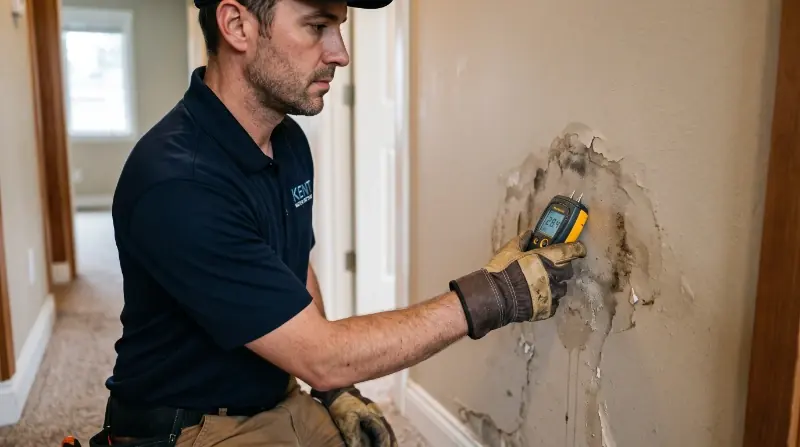
How long do galvanized pipes last in Kent, WA?
Understanding how galvanized corrosion progresses helps homeowners recognize where their system sits on the failure timeline.
Years 1–30: Zinc Protection Phase
The zinc coating is intact and actively preventing steel corrosion. Water flow is normal. No visible issues. For Kent homes built before 1975, this phase ended decades ago.
Years 30–50: Scale Buildup Phase
Zinc layer thinning. Iron oxide deposits building on inner pipe walls. Gradual pressure reduction throughout the system. Water may run brown or orange briefly when taps are first opened. This is where most Kent homes built in the 1960s and early 1970s sit today.
Years 50+: Active Failure Phase
Pipe walls thinned to failure threshold. Burst failures occur without warning — often at night or while the house is unoccupied, maximizing damage. Pinholes develop at joints and mid-pipe. Kent homes built before 1975 are in this zone now.
The critical thing to understand about the active failure phase: galvanized pipe bursts happen without warning. Unlike copper pinhole leaks that often drip slowly for months before failing, galvanized failures tend to be sudden — a section of pipe wall that has thinned to a fraction of its original thickness collapses under normal water pressure. The resulting discharge is immediate and high-volume.
How do I tell if my Kent home has galvanized pipes?
Identifying your pipe material takes about five minutes and no tools beyond a flashlight and a refrigerator magnet.
Visual identification
Galvanized pipes are silver-gray when clean, developing orange-brown rust staining over time. They have threaded connections with bulkier fittings than copper or plastic. Look in crawlspaces, under sinks, or in the basement utility room where pipes are exposed.
Magnet test
A refrigerator magnet sticks strongly to galvanized steel. It does not stick to copper (non-magnetic) or to plastic pipes (PVC, CPVC, PEX). This is the fastest way to distinguish galvanized from copper when both look silver-gray in dim light.
Water color test
Run the cold tap in a bathroom or kitchen for 10 seconds. If the water runs brown or orange for the first few seconds before clearing, that is iron oxide flushing out of corroded galvanized interior walls. Clear tap water does not rule out galvanized, but discolored water is a strong indicator.
Build date
Any Kent home built before 1975 and never repiped almost certainly has galvanized supply lines. The transition from galvanized to copper in new construction happened gradually through the late 1960s and early 1970s. A home built in 1968 may have a mix of galvanized mains and copper branches.
Which Kent neighborhoods have the most galvanized pipe?
Different Kent neighborhoods have different galvanized pipe risk profiles based on construction era and housing density.
Ranch homes 1968–1985. Mix of galvanized mains and early copper. Highest concentration of galvanized still in service in Kent.
1972–1988 homes. Later construction era means more homes transitioned to copper earlier, but galvanized mains still common in pre-1976 homes.
Older housing stock including pre-1960 homes. Some of the oldest galvanized systems in Kent. Combined with crawlspace flooding risk from Green River floodplain.
Primarily 1975–2000 construction. Most homes transitioned to copper or CPVC. Galvanized less common but CPVC brittleness is the primary risk here.
What happens when a galvanized pipe bursts in Kent?
A galvanized pipe burst in a Kent home is a two-trade event: a licensed Washington State plumber handles the pipe repair or repipe, and WA Restore Pro handles the water damage restoration. These happen in sequence, not simultaneously.
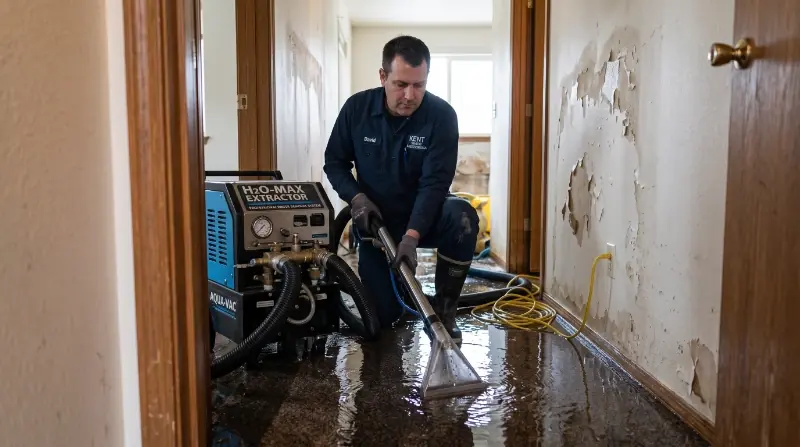
Shut off the main water supply
The main shutoff for most Kent homes is near the water meter at the property line or in the garage. Turn it clockwise until fully closed. This stops the discharge but does not drain the remaining water in elevated pipes — that continues to flow for several minutes.
Call WA Restore Pro — (831) 230-1431
We dispatch a restoration contractor immediately and coordinate a licensed WA plumber to assess and repair the pipe while the restoration crew begins water extraction and moisture mapping on arrival. You deal with one call for both trades.
Document everything before moving anything
Photograph all visible water, affected rooms, and the failed pipe location before moving furniture or belongings. These photographs are your insurance claim evidence.
Extraction, drying, and restoration
The contractor extracts standing and absorbed water, maps moisture migration with FLIR thermal imaging, places LGR dehumidifiers and air movers, and documents drying progress daily to IICRC S500 standard for your adjuster.
Galvanized pipe questions
How do I know if my Kent home has galvanized pipes?
Galvanized steel pipes are silver-gray and magnetic — a refrigerator magnet sticks to them. Homes built in Kent before 1975 almost certainly have galvanized supply lines. Look in your crawlspace or under sinks for exposed pipe. Discolored water when you first run a tap is another indicator of interior galvanized corrosion.
How long do galvanized pipes last in Kent, WA?
Galvanized pipes have a rated service life of 40 to 70 years. Most Kent homes with original galvanized supply lines built before 1975 are now at or past this range. Kent's chlorine-treated municipal water accelerates interior corrosion compared to unchlorinated water, often placing actual failure at the lower end of the service life range.
Does insurance cover a galvanized pipe burst in Kent, WA?
Yes, if the failure is sudden and accidental. A galvanized pipe that bursts without prior signs of a known leak is typically covered as a sudden and accidental loss. The water damage restoration is covered beyond your deductible. The pipe repair itself is usually not covered. Prompt response and professional documentation protect your claim from gradual-leak denial arguments.
Should I repipe my Kent home or just repair the failed section?
If the pipe that failed is galvanized and the home is pre-1975, the rest of the distribution system is equally corroded. A spot repair buys time but not a solution. Multiple failures within a 2-year period, discolored water, or low pressure throughout the house are all signs that a full repipe is the more cost-effective long-term answer. See our repiping Kent WA guide for details and cost estimates.
Galvanized Pipe Burst in Your Kent Home?
60-minute response across all Kent ZIP codes. We handle extraction, drying, and insurance documentation while coordinating your licensed plumber.
(831) 230-1431