Burst Pipe Restoration in Kent, WA
Last updated: October 2026
Burst pipe cleanup and water damage repair in every Kent ZIP code. Licensed, IICRC-certified contractors, direct insurance billing, and on-site response targeted within 60 minutes.
Burst pipe restoration in Kent, WA requires immediate water extraction, structural drying to IICRC S500 standards, and full damage documentation for insurance. Most Kent homes were built between 1970 and 1985, placing galvanized steel, copper, and CPVC pipes at 40 to 55 years old in 2026. The Green River Valley's high water table adds hydrostatic pressure on crawlspace pipes in ZIP codes 98032 and 98031 year-round. Emergency response is available 24/7 across all Kent neighborhoods, and WA Restore Pro handles direct billing to your insurance carrier.
Burst pipe repair in Kent: what happens after you call?
Direct answer: your call routes to a licensed, IICRC-certified Kent contractor who arrives within about 60 minutes, extracts standing water the same day, dries the structure to the IICRC S500 standard over 3–7 days, and bills your insurer directly for the restoration scope.
Burst pipe repair in Kent is really two jobs. A licensed plumber fixes the failed line, usually the same day the water is shut off, and the restoration contractor dries and rebuilds everything the water reached. One call starts both, so you are not chasing two companies while the subfloor stays wet.
Every burst pipe loss in Kent follows the same sequence. We handle all three phases with the same crew and the same documentation chain — no handoffs, no gaps in your insurance record.
Water Extraction
Truck-mounted pumps and crawlspace submersibles remove standing water at 10 to 15 times the rate of consumer equipment. A burst supply line releases 4 to 8 gallons per minute — extraction speed directly determines how much material can be saved.
Structural Drying
Commercial LGR dehumidifiers and air movers run continuously for 3 to 5 days following IICRC S500 psychrometric standards. Dry standard is confirmed by calibrated moisture meter — not visual inspection. Daily logs go to your adjuster.
Mold Prevention
Kent's Pacific Northwest climate means mold can begin growing within 24 to 48 hours of water exposure, per EPA guidance. Fast response and complete drying to S500 standard is the only way to prevent it. Every job is treated as a 24-hour race.
Why do Kent, WA homes have more burst pipes than the rest of King County?
Three forces work against Kent's aging plumbing every winter. Understanding them is the difference between a three-day restoration job and a three-week mold remediation.
Aging Pipe Materials
Most Kent homes were built between 1970 and 1985. Galvanized steel, copper, and CPVC pipes from that era are now 40 to 55 years old — at or past their rated service life. The homes near Kentridge High School on SE 208th Street and Kent-Meridian High School on SE 256th Street sit in this exact failure window. Galvanized corrodes internally without warning. CPVC becomes brittle and cracks from thermal stress. Copper develops pinholes behind drywall for weeks before anyone notices.
Green River Valley Water Table
Kent sits on a floodplain. King County maintains 28 miles of levees and revetments throughout the Green-Duwamish watershed. The water table beneath the valley floor stays within a few feet of the surface from October through April, pushing groundwater against crawlspace floors and buried pipes in 98032 every winter. In December 2025, the Green River jumped its banks near West Valley Highway, closing Frager Road at West Meeker Street and Russell Road at Veterans Drive — conditions that stressed buried pipes throughout the valley even in homes that did not directly flood.
Pacific Northwest Atmospheric Rivers
Kent receives 44 to 50 inches of rainfall per year, concentrated from November through March. Atmospheric rivers bring surges that can drop several inches in 48 hours, raising groundwater levels and stressing aging pipe systems throughout the city. Freeze-thaw cycles in uninsulated crawlspaces during Arctic outflow events from the Cascades crack CPVC and copper pipes that have been weakened by decades of thermal cycling. The combination of saturated soil, old pipes, and temperature swings is what makes Kent one of the most active burst pipe markets in South King County.
What Pipe Material Is in Your Kent Home?
Construction era determines pipe material. Pipe material determines failure risk. Here is the full timeline for Kent's housing stock.
Downtown Kent, older Riverview properties
Original galvanized supply lines, now 60 to 80 years old. Internal corrosion progressively narrows the pipe until the wall fails suddenly. First sign is rust-orange water at the tap and declining pressure. By the time discoloration is consistent, failure is imminent.
East Hill, Scenic Hill, Kent-Meridian HS area
Copper was the standard material for most East Hill and Scenic Hill homes. Green River water chemistry can carry elevated manganese and iron, which accelerates internal pitting. Pinholes develop behind walls and drip silently for weeks before a ceiling stains or a floor goes soft. Homes near SE 256th Street and the streets above James Street are most commonly in this era.
West Hill, Panther Lake, Panther Lake Elementary area
CPVC service life is 20 to 35 years. A house built in 1985 with original CPVC is 41 years old in 2026 — well into the brittle phase. CPVC cracks without visible external warning under thermal stress, physical impact, or from pipe thread sealants that are chemically incompatible with CPVC chemistry.
Lake Meridian area, Kentlake High School on SE Falcon Way
Newer subdivisions near Kentlake High School built before 2010 sometimes have early PEX fittings with chlorine byproduct compatibility issues. If your home is in 98042 and was built between 1995 and 2010, ask a plumber about your specific fitting brand if you notice unexplained moisture.
Newer builds across all Kent ZIP codes
Homes built after 2010 typically have modern PEX plumbing with updated fittings. Lower burst risk overall, though supply line angle stop failures remain common regardless of pipe material.
How fast does burst pipe water damage spread in a Kent home?
The EPA's guidance on indoor mold and moisture states that mold can begin growing in porous building materials within 24 to 48 hours under favorable temperature and humidity conditions. Kent's Pacific Northwest climate provides those conditions most of the year. A three-day restoration job becomes a three-week mold remediation project when response is delayed. Drywall that is wet for more than 48 hours typically cannot be dried in place — it must be cut out and replaced. Hardwood subfloors begin to cup and buckle within hours of water contact.
The cost difference between calling within the first hour and calling two days later is measured in thousands of dollars and weeks of disruption.
Call Now — (831) 230-1431How does burst pipe restoration work in Kent, WA?
From emergency call through final reconstruction — what happens at each stage, and why each step matters for your insurance claim and your home.
Emergency Response
You call. We pick up — a vetted local contractor who knows Kent. We roll within minutes with all extraction and drying equipment already loaded. Most Kent addresses in 98030, 98031, 98032, and 98042 get a crew on-site within 60 minutes.
Water Extraction
Truck-mounted pumps remove standing water at volumes that consumer wet-vacs cannot approach. A burst supply line releases 4 to 8 gallons per minute. Portable submersible pumps handle crawlspaces, which is where most Kent Valley losses originate. Extraction begins immediately on arrival.
Moisture Mapping
Thermal imaging cameras and penetrating moisture meters map water migration behind walls, under floors, and inside cabinet bases. Water travels up to 8 to 10 feet from the visible wet area without showing on the surface. Skipping this step means walls get closed with wet framing inside — and mold follows within 24 to 48 hours.
Structural Drying
Commercial LGR dehumidifiers and high-velocity air movers run continuously until moisture readings return to pre-loss baselines — typically 3 to 5 days. We follow IICRC S500 psychrometric standards and check readings daily. You receive every moisture log. Walls are not closed until dry standard is confirmed by calibrated meter, not visual inspection.
Insurance Documentation
While equipment runs, we prepare your full claim package: photographs taken before, during, and after remediation; moisture logs with timestamps; equipment placement records; a line-by-line Xactimate estimate in the format adjusters use. We submit directly to your carrier and respond to any requests for additional documentation. Washington State law gives you the right to choose your own contractor — your carrier cannot require you to use their vendor list.
Reconstruction
Once the structure reaches dry standard and the insurance scope is approved, we repair or replace damaged drywall, flooring, insulation, trim, and cabinetry. We coordinate with Washington State licensed plumbers for pipe repairs and sequence both trades to complete without conflict. Our goal is pre-loss condition — not just technically dry and handed back.
Typical Kent Burst Pipe Restoration Scenarios
Representative restoration scenarios based on typical Kent burst pipe losses.
Crawlspace Galvanized Failure — 1974 Ranch on SE 208th
A galvanized supply line in the crawlspace failed while the homeowner was at work. Six hours of water into a crawlspace beneath a 1974 East Hill ranch. Subfloor above the crawlspace showed elevated moisture across four rooms. The bedroom nearest the crawlspace access in the garage had soft flooring that felt normal from the surface.
Submersible pumps extracted crawlspace water. Thermal imaging showed moisture migration 14 feet from the failure point. Fourteen air movers and four LGR dehumidifiers ran for five days. Subfloor dried to 11% from 38%. Original fir subfloor saved.
Bathroom Angle Stop — Riverview Home Near Frager Road
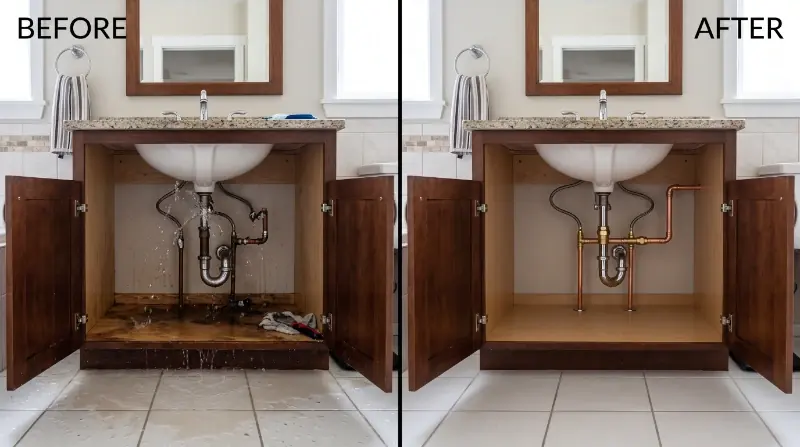
A 1978 angle stop under the bathroom sink failed on a Saturday afternoon while the homeowner was out. Water ran for three hours, through the cabinet base, across the bathroom floor, and into the hallway subfloor. The tile surface looked undamaged. The subfloor underneath was saturated, and the wall cavity behind the vanity held moisture 22 inches up from the base plate.
Thermal imaging confirmed water migration into the adjacent bedroom wall. Drywall opened at two locations for access. Four-day drying cycle. Insurance documentation submitted within 24 hours of arrival.
Hidden CPVC Failure — West Hill Bluff Home, 98032
Homeowner noticed a musty smell in a bedroom. No visible staining, no soft flooring. Thermal imaging revealed a six-foot zone of moisture inside the wall near a plumbing chase — traced to a CPVC crack at a fitting behind the wall. The pipe had dripped into the wall cavity for approximately three weeks without any surface sign. Mold had established in the insulation.
Two-location wall opening for access. Full mold remediation per IICRC S520. New CPVC section installed by licensed plumber. Reconstruction after 6-day drying cycle.
Which Kent neighborhoods does the contractor network cover?
Each area has different pipe materials, different terrain risks, and different failure patterns. We come prepared for each one.
East Hill-Meridian
Ranch homes 1968 to 1988 near Kentridge HS. Galvanized and CPVC pipes at failure age. Higher terrain pressure on angle stops.
West Hill
Bluff homes with crawlspace flooding, tree-root sewer failures in aging clay lines. Water follows slope fast when pipes fail.
Kent Valley
Green River floodplain. High water table year-round. Near Frager Road South and Riverview. December 2025 flood area.
Scenic Hill
Established 1970s to 1980s homes. Angle stop failures and windstorm roof damage. Adjacent to Salt Air Hills.
Lake Meridian
Near Kentlake HS on SE Falcon Way. Lake humidity, early PEX fittings, foundation seepage on slopes.
Panther Lake
CPVC failure era homes near Panther Lake Elementary. Hillside drainage and bluff proximity.
Downtown Kent
Near Kent Station and accesso ShoWare Center. Mixed-use older buildings. Oldest plumbing stock in the city.
Mill Creek
Canyon terrain, groundwater saturation every winter. Sump pump failures lead to rapid crawlspace flooding.
Do you handle burst pipes outside Kent, in the rest of King County?
Yes. The same referral line routes burst pipe calls from 14 more King County cities to licensed restoration contractors who work those areas. Start with the King County burst pipe restoration hub, or pick your city below. For a deeper read on pipe materials, water chemistry, cold snaps and Washington claim rules across the county, see the King County burst pipe guide.
Renton
Cedar River valley floor, the WWII-era Highlands and Fairwood subdivisions on city well and spring water.
Auburn
Green and White River valley homes below the Lea Hill and Lakeland Hills plateaus.
Federal Way
Upland neighborhoods from Steel Lake to Twin Lakes and Dash Point, served by Lakehaven.
Tukwila
Allentown, Foster and Riverton homes beside Green River levees, on soft Seattle-sourced water.
SeaTac
Sound-insulated homes under the flight path around McMicken Heights and Angle Lake.
Burien
Postwar homes, Seahurst and Three Tree Point shoreline houses with aging copper and galvanized lines.
Des Moines
Marina-district condos, Redondo and Zenith homes built mostly from 1950 to 1980.
Covington
Newer Soos Creek plateau subdivisions where PEX fittings and supply hoses fail.
Maple Valley
Four Corners to Lake Wilderness, with rural lots, wells and Cedar River exposure.
Black Diamond
Old coal-town cabins, Lake Sawyer homes and new Ten Trails construction at 558 feet.
Enumclaw
Plateau homes, farms and well systems exposed to hard east winds off the Cascades.
Shoreline
Postwar ramblers, Aurora corridor condos and Richmond Beach bluff homes.
Kenmore
Lake Washington north-shore and hillside homes near the Sammamish River.
Bothell
A city split by the King–Snohomish county line, from downtown to Canyon Park.
ZIP code and neighborhood pages
Latest burst pipe guides
King County burst pipe guide
Pipe materials by decade, water chemistry, cold snaps and WA claim rules in one place.
Pipe burst in Renton: the first 60 minutes
What to shut off, who to call and what to photograph before anyone arrives.
Renton burst pipe insurance walkthrough
Cedar River flood vs pipe burst, condo HO-6 and renter HO-4 claims.
Auburn frozen pipe guide
Crawlspace vents, hose bibs and thawing a line safely when Sea-Tac drops into the teens.
Federal Way renters and landlords
RCW 59.18 repair deadlines and who pays when an apartment pipe bursts.
Tukwila business burst pipe playbook
Retail, warehouse and hotel leaks, sprinkler breaks and business interruption.
Burien galvanized pipe repair guide
Patch, line or repipe an older Burien house, with typical costs.
Des Moines condo burst pipes
Master policy, HO-6 and unit-to-unit leaks in waterfront buildings.
Why newer Covington homes flood too
PEX fittings, washer hoses and ice maker lines in 1990s–2010s builds.
Maple Valley outage and frozen pipes
An hour-by-hour plan for when the power and heat go out.
Repair vs repipe in Kent homes
When patching stops making sense for galvanized and CPVC lines.
Does homeowner insurance cover a burst pipe in Kent, WA?
Direct answer: yes — a sudden burst pipe is covered under standard Washington homeowner policies for the water damage restoration, minus your deductible. The pipe repair itself and long-term seepage are not covered.
Most Kent homeowners do not know their rights until a claim gets denied. Here is what the law actually says.
Your Rights Under Washington State Law
What should you check before hiring a burst pipe restoration company in Kent?
We checked what competitors actually do — not what their websites claim. Here is the real comparison.
5 Things to Confirm Before Any Restoration Company Starts Work
RCW 18.27 requires all contractors to provide their registration number in advertising. Verify it at lni.wa.gov before work begins.
IICRC WRT (Water Restoration Technician) is the industry standard for water damage restoration. Verify at iicrc.org — it's a public database.
Xactimate format is the insurance industry standard. A company that won't provide a written scope before placing equipment is not protecting your claim.
For covered losses, a legitimate restoration company bills your carrier directly. You should not need to pay upfront and wait for reimbursement.
IICRC S500 standard requires daily documentation of moisture readings. These logs go to your adjuster and protect your claim if the restoration timeline is disputed.
Burst Pipe by Pipe Material — Kent, WA
The pipe type in your Kent home determines how it fails and what the warning signs are. Select your pipe material for a complete guide.
Pre-1975 homes • Corrodes inside-out • Most common in Kent
Copper Pipe Burst1960–2000 homes • Pinhole leaks • Chlorine pitting
CPVC Pipe Burst1975–2000 homes • Brittle failure • No warning signs
PEX Pipe Burst1985–2010 homes • Fitting failures • Early-gen issues
Water Heater BurstTank rupture • PRV failure • Supply line failure
Frozen Pipe BurstCrawlspace • Exterior wall • Freeze-thaw cycles
Supply Line FailureToilets • Washing machines • Sinks • Fridges
Ceiling Water DamageUpstairs leak • Sag • Collapse
Slab LeakKent Valley • Warm floor spot • Reroute
Commercial & WarehouseSprinkler lines • Mains • Kent Valley
Not sure what pipe type you have? Use our Plumbing Risk Calculator or read the galvanized pipe identification guide.
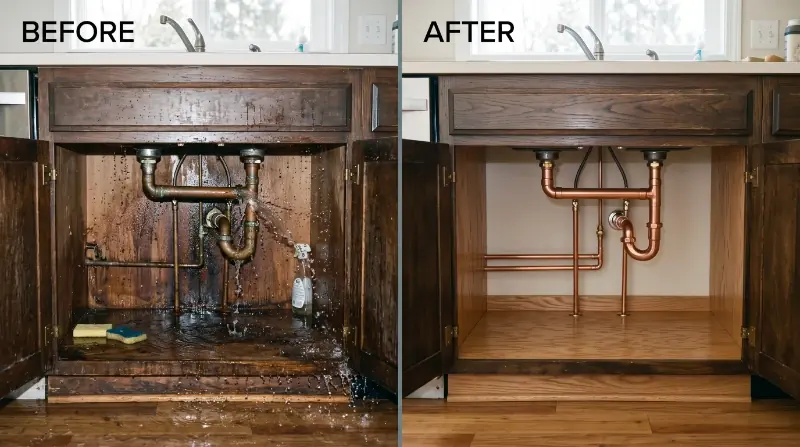
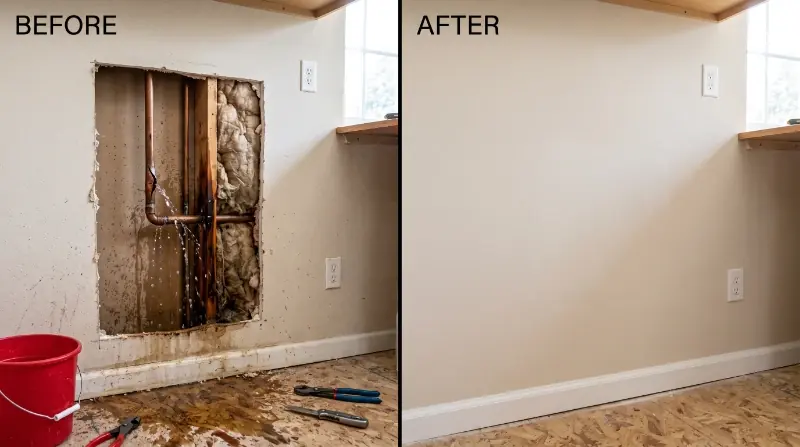
Before & After Restoration in Kent, WA
Representative restoration work from Kent, WA homes. Same IICRC S500 process and insurance documentation on every job.



How much does burst pipe restoration cost in Kent, WA?
Direct answer: $1,500 to $4,500 for a single room, $4,500 to $9,000 across several rooms, and $8,000 to $18,000 when mold remediation is added. Use the estimator below for your scenario.
| Scenario | Typical Kent range | What is included |
|---|---|---|
| Single room (bathroom / kitchen) | $1,500 – $4,500 | Extraction, drying, drywall |
| Multi-room / hallway spread | $4,500 – $9,000 | Extraction, LGR drying, subfloor |
| Crawlspace flooding | $2,500 – $8,000 | Submersible pump, framing drying |
| Multi-room + mold remediation | $8,000 – $18,000 | Full restoration + mold protocol |
| Water heater / major supply failure | $3,000 – $12,000 | High-volume extraction, rebuild |
Kent, WA ranges through the WA Restore Pro contractor network. Restoration is covered by insurance beyond your deductible for sudden losses.
Use these before you call anyone. Know your risk. Know your costs.
Is My Kent Home's Plumbing at Risk?
4-step calculator — enter your build year, neighborhood, and current symptoms. Get a scored risk assessment for your specific Kent home.
Burst Pipe Restoration Cost Estimator
5-step tool — rooms affected, flooring type, how long water ran, additional factors, and your deductible. Get a personalized cost range with insurance breakdown.
Burst Pipe Questions Kent Homeowners Ask First
Whether you searched for burst pipe cleanup, broken pipe water damage repair, or emergency water damage restoration in Kent, the answers below cover the first calls homeowners make. Free estimate on every job, same day.
Pipe Burst in Kent Right Now?
We answer every call. A licensed local contractor picks up — a vetted local contractor who knows Kent. On-site in 60 minutes across all Kent ZIP codes.
(831) 230-1431Free Estimate · Serving 98030 · 98031 · 98032 · 98042 · All Kent, WA · Licensed · Insured · IICRC Certified
How WA Restore Pro works: We are a Kent-based restoration referral platform (lead-to-pro model). Restoration work is performed by independently licensed Washington State contractors. The contractor's current L&I registration number is provided before any work begins. Learn more →