Supply Line Failure in Kent, WA — Toilets, Washing Machines, Sinks & Refrigerators
Last updated: October 2026
Supply line failures — at toilets, sinks, washing machines, refrigerators, and dishwashers — are the leading cause of residential water damage claims in Kent, WA. A supply line can discharge 4 to 8 gallons per minute at normal household pressure. Left unattended for hours, a single failed toilet supply line can cause $10,000 to $50,000 in water damage. These failures are covered by standard homeowner insurance as sudden and accidental losses. Call (831) 230-1431 — WA Restore Pro responds within 60 minutes across all Kent ZIP codes.
Supply line failures are one of the most common jobs our Kent burst pipe restoration service handles — extraction and drying begin within 60 minutes of your call.
What is a supply line and why do they fail?
A supply line is the flexible connector between a shutoff valve (angle stop) and a plumbing fixture — toilet, bathroom sink, kitchen sink, dishwasher, refrigerator ice maker, or washing machine. These connectors are typically 12 to 24 inches long, made from braided stainless steel over polymer tubing, corrugated copper, or rubber.
Supply lines fail for two reasons: material degradation and mechanical damage. Braided stainless supply lines have a rated service life of 5 to 10 years. The polymer tubing inside the braided jacket degrades under sustained water pressure — microscopic cracks develop in the polymer, and the braid that was holding the tube together gives way. The result is an instantaneous full-flow failure at normal household pressure.
In Kent homes, supply line failures are especially common because of a specific cascade: aging galvanized main supply lines create scale deposits that pass downstream into supply line fittings, accelerating degradation of the polymer interior. Kent homes with galvanized mains that also have original supply line connectors at every fixture represent a compound failure risk.
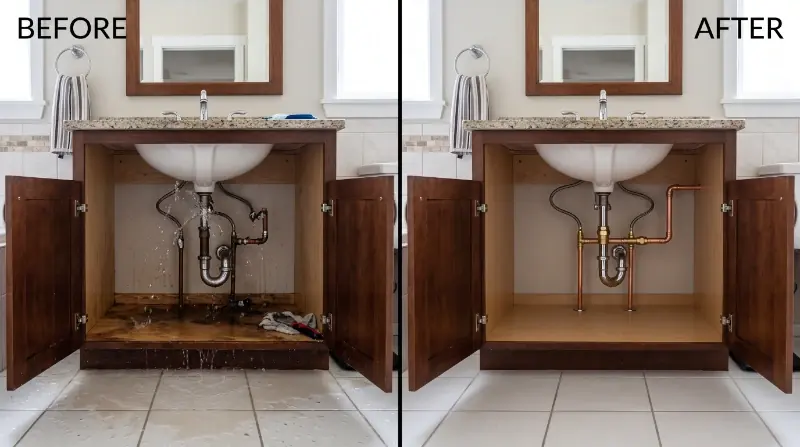
Which five supply lines fail most often in Kent homes?
1. Toilet supply lines — every bathroom
The most common source of supply line water damage. Every toilet has one 12-inch supply line between the angle stop and fill valve. Most are never replaced. In Kent homes built before 2000, original supply lines are common — many over 20 years old and well past rated service life. A toilet supply line failure in a second-floor bathroom can cause ceiling damage to the room below.
2. Refrigerator ice maker supply lines
The ¼-inch supply line running behind the refrigerator to the ice maker is frequently crimped when the refrigerator is moved for cleaning or replacement. A crimped line can fail months later when pressure finally overcomes the damaged wall. The refrigerator is typically moved back against the wall, hiding the failed line until water appears in the adjacent room.
3. Washing machine supply hoses
Two hoses — hot and cold — connect the washing machine to the wall valves. Standard rubber hoses degrade under sustained pressure and heat cycling. The Insurance Institute for Business and Home Safety recommends replacing rubber washing machine hoses every 5 years. Braided stainless hoses have a longer service life. In Kent, washing machine hose failures during a wash cycle with no one home are a common catastrophic loss scenario.
4. Bathroom and kitchen sink supply lines
Two supply lines per sink — hot and cold — run inside vanity cabinets and under kitchen sinks, where they are often exposed to cleaning product spills and moisture. The cabinet environment accelerates polymer degradation. Failures under kitchen sinks can saturate cabinet floors and migrate under the dishwasher without visible surface signs for days.
5. Dishwasher supply and drain lines
The dishwasher hot water supply line and drain hose run under the kitchen sink. The supply line is under constant pressure whenever the shutoff is open. The drain hose experiences pressure cycling with every wash cycle. Dishwasher line failures saturate the cabinet floor and migrate under adjacent base cabinets before becoming visible.
How much does supply line failure restoration cost in Kent?
The variable is almost entirely time. A braided line that lets go while you are standing in the room costs a fraction of the same line failing on a Friday night.
| Scenario | Typical Kent range | Who pays |
|---|---|---|
| Caught within minutes, one cabinet or floor area | $900 – $2,200 | Insurer, minus deductible |
| Ran a few hours, one room plus subfloor | $2,500 – $6,000 | Insurer, minus deductible |
| Overnight failure, multiple rooms | $6,000 – $14,000 | Insurer, minus deductible |
| Second-floor line, ceiling below damaged | $6,000 – $16,000 | Insurer, minus deductible |
| Weekend or vacation failure with mold | $10,000 – $25,000 | Insurer; may query delayed discovery |
| Replacing every supply line in the house | $400 – $1,200 | Homeowner (preventive) |
Kent, WA ranges through the WA Restore Pro contractor network, 2025-2026. A whole-house supply line replacement costs less than most deductibles.
Why do Kent homes fail more supply lines than they should?
Two local factors stack. First, Kent's housing stock has a lot of original fixtures: a 1972 East Hill ranch that has never had a bathroom remodel may still have its original angle stops and lines, fifty-four years on. Second, the hill neighborhoods run higher static pressure than the valley, and braided lines are rated for pressure ranges that assume a working pressure regulator. Kent homes where the regulator has failed — common in houses over thirty years old — can sit at 90 to 100 psi continuously, which shortens the life of every flexible connector in the building.
A $12 pressure gauge screwed onto a hose bib answers this in one minute. Anything over 80 psi means the regulator needs attention, and it is the cheapest single thing you can do to extend the life of every supply line, valve, and appliance in the house.
What should I do when a supply line fails in Kent?
Shut off the angle stop valve under the fixture
Every fixture has its own shutoff valve — the angle stop — immediately below or behind it. Turn it clockwise to close. If the angle stop is seized or broken (common in older Kent homes), shut off the main house water supply at the meter.
Call WA Restore Pro immediately — (831) 230-1431
Even a small supply line failure can cause significant hidden damage inside cabinets, under flooring, and inside walls. Early professional extraction prevents the secondary mold growth that turns a small claim into a major one.
Document all visible damage before moving anything
Photograph standing water, affected cabinets, flooring, and the failed supply line before cleanup. These images are your insurance claim documentation.
Extraction and hidden moisture mapping
The contractor extracts visible water and uses FLIR thermal imaging to locate moisture that has migrated under floors, inside walls, and under adjacent cabinets. Supply line failures inside cabinets frequently saturate sub-cabinet areas that show no surface signs.

Supply Line Failure FAQs — Kent, WA
Is a supply line failure covered by homeowner insurance in Kent, WA?
Yes. A sudden supply line failure — at a toilet, sink, washing machine, or refrigerator — is a sudden and accidental covered loss under standard homeowner insurance beyond your deductible. The water damage restoration is covered. The supply line itself is a low-cost replacement item. WA Restore Pro bills your carrier directly for the restoration scope.
How much water can a supply line release in Kent?
A supply line failure at normal household water pressure discharges 4 to 8 gallons per minute. A failure discovered 8 hours after it occurred — overnight, or during a workday — can release 1,920 to 3,840 gallons before discovery. Even a 2-hour undetected failure produces 480 to 960 gallons — enough to saturate subfloor, migrate under walls into adjacent rooms, and cause mold-risk conditions throughout the floor level.
How can I prevent supply line failures in my Kent home?
Replace braided stainless supply lines at every fixture every 7 to 10 years, regardless of apparent condition. Replace rubber washing machine hoses every 5 years. When you replace a toilet, sink faucet, or appliance, always install new supply lines at the same time. Consider a whole-house water shutoff device with leak detection — these systems shut off the main supply automatically when a flow anomaly is detected.
Supply Line Failure in Your Kent Home?
60-minute response across all Kent ZIP codes. We handle extraction, drying, and insurance documentation.
(831) 230-1431Related Kent burst pipe pages
Sources referenced on this page
- Washington OIC — leaks, water damage and mold coverage
- Washington L&I contractor verification
- IICRC S500
Last updated: October 20, 2026. Reviewed against the City of Kent Water Quality Report and IICRC S500 standard.