Burst Pipe Renton Highlands: Help for Wartime Homes and Patchwork Plumbing
Last updated: October 2026
Many Highlands homes started as 1940s war-worker housing and have been remodeled ever since. When a crawlspace line or old galvanized joint fails, we connect you with a licensed restoration crew.
Burst pipe in Renton? Shut off the main, then call. Your call routes to a licensed local restoration contractor.
A burst pipe Renton Highlands owners face often starts in a crawlspace under a house built as wartime housing and remodeled several times since. Shut the main valve (look where the supply line comes through the foundation or under the kitchen sink), turn off the water heater, and call (831) 230-1431. Your call goes to a licensed, IICRC-certified restoration crew aiming to be on-site within 60 minutes, while a licensed plumber handles the pipe repair.
Why are so many Renton Highlands homes older than they look?
Because a large part of the Highlands was built in a rush for World War II defense workers, and much of that "temporary" housing was never torn down. It was sold, lived in, added onto and updated for eighty years.
Developers had been calling the plateau east of downtown "Renton Highlands" since the 1930s, but the neighborhood's real start came in May 1942, when the Federal Public Housing Authority began building homes there for workers at Boeing and PACCAR. Boeing's Renton plant, built by the Navy in 1941, turned out B-29 bombers during the war, and Renton's population ballooned to about 16,000, roughly three and a half times its pre-war size. The city museum notes that $4 million in federal money arrived with Boeing for housing and streets.
HistoryLink describes temporary housing "erected on a large scale" in the Highlands and says many of those so-called temporaries still exist. When the war ended, Renton annexed the Highlands war housing and added 7,500 residents in one move. Citywide, the Housing Authority of the City of Renton built 3,000 dwellings near the Boeing and PACCAR lines under the Lanham Act, with a federal cap of $3,000 per unit. Most were sold to the defense workers who lived in them during the 1950s, and many are still standing.
The neighborhood even got its own library in 1944 for war workers. Today the Renton Highlands Library at 2801 NE 10th Street, opened in March 2016, sits in a neighborhood that's changing again: the Sunset Terrace public housing, a deteriorating wartime development, is being replaced through the Sunset Area redevelopment, and new apartments and condos are going up.
So a Highlands street can hold an altered 1940s cottage, a 1960s infill rambler, a 2010s townhouse and a brand-new apartment building within a few hundred feet. From a plumbing point of view, that's four very different risk profiles.
What's actually inside the walls after eighty years of remodels?
Usually a patchwork: some original metal pipe, some copper from a mid-century update, PEX from a recent bathroom, and transition fittings joining them. The joints between materials are where trouble tends to start.
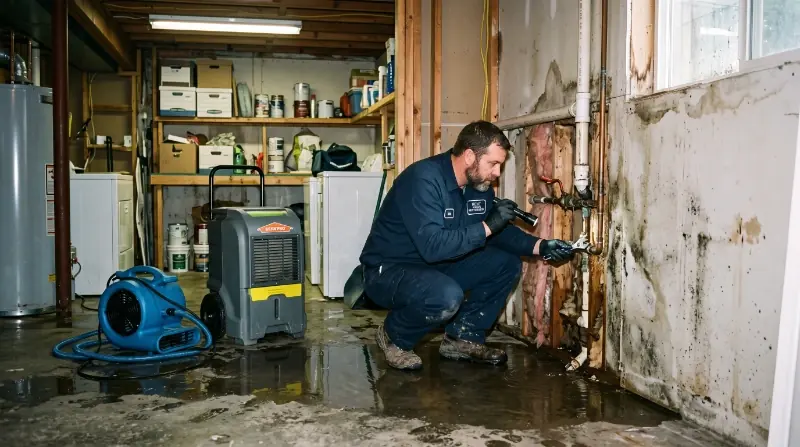
We can't tell you what's in any particular house without someone looking. But homes from the 1940s commonly had galvanized steel supply lines, because copper and plastic piping weren't the norm yet for housing like this. Over decades, owners replaced pieces as they failed. One kitchen remodel swapped the sink lines to copper. A later bathroom used PEX and a push-fit coupling. The run under the floor to the laundry may still be original.
That history creates a few specific weak points:
- Dissimilar-metal joints. Where galvanized steel meets copper without a proper dielectric union, galvanic corrosion eats at the steel. Those joints often show white or orange crust long before they leak.
- Galvanized interior buildup. Old galvanized pipe rusts from the inside, narrowing the bore. Low pressure at one faucet, rusty water after the system sits overnight, or a pinhole weep at a threaded nipple are classic signs. Our guide to identifying the pipes in your house shows what each material looks like.
- Old solder and fixtures. Renton's 2026 water quality report flags pre-1986 homes as the likeliest to contain lead solder or lead-bearing fixtures. The city's 2025 lead and copper sampling of 53 homes showed a 90th-percentile lead result of 1.9 ppb, well under the 15 ppb action level, with zero exceedances. Still, any wall opened during restoration is a chance to replace old soldered fittings.
- DIY repairs from decades past. Hose clamps over a pinhole, epoxy putty on a threaded joint, a SharkBite coupling buried in an insulated crawlspace. These are common finds, and none of them were meant to be permanent.
Crawlspaces carry most of the risk
Many older Highlands houses sit over a vented crawlspace rather than a basement or slab. Supply lines run under the floor joists, often with little or no insulation. In a freeze, that's the coldest place your plumbing lives. And when a line bursts down there, nobody sees it. The first clue is often a hissing sound, a spike on the water bill, or a damp, musty smell coming up through floor registers.
Galvanized pipe repair or a full repipe: which makes sense in the Highlands?
If the failure is a single isolated section and the rest of the pipe still has decent flow, a repair can be reasonable. If you've had more than one leak in a year, or the pipe is galvanized throughout, a repipe usually costs less over time.
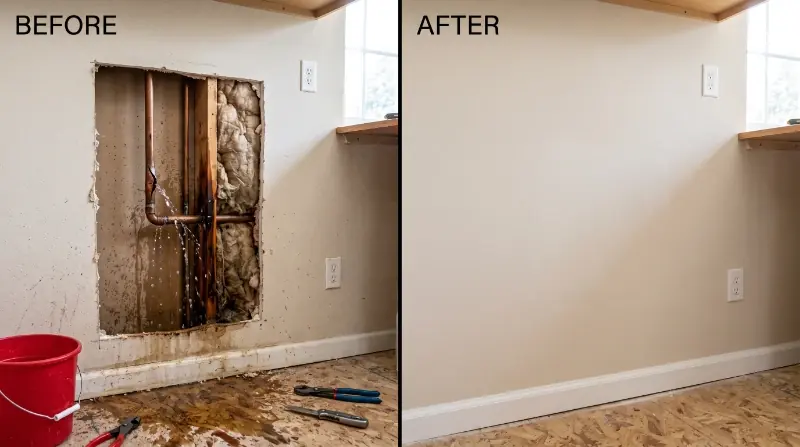
This is a plumber's decision to make with you, not a restoration contractor's. But it affects the restoration plan, so it's worth understanding before walls get opened. The table below is general guidance; every house is different.
| Situation | Spot repair | Repipe |
|---|---|---|
| One split section in a crawlspace, rest of the system copper or PEX | Usually fine. Commonly $150 to $600 for a simple section. | Not needed |
| Leak at a galvanized-to-copper joint, other joints crusted | Fixes today's leak only | Worth pricing |
| Second or third leak in a year, rusty water, low pressure | Money spent twice | Usually the better value |
| Walls already open for drywall removal after the burst | Possible | Good timing, since access is already paid for |
Whole-home repipes commonly land somewhere from about $4,000 to $15,000-plus, with house size and pipe material driving the spread. In a small single-story Highlands home with crawlspace access, PEX runs can be fished with fewer wall openings than in a two-story house. Pipe lining is mostly used for drain and sewer lines rather than small supply piping, so ask the plumber whether it applies to your situation. See our repair-versus-repipe guide and the galvanized pipe burst page for more detail.
One local rule to know: Renton's municipal code says no one may replace a plumbing system without a permit, and the city issues plumbing and mechanical permits over the counter, usually the same day, through its Civic Access self-service portal. A licensed plumber pulls that permit. If someone offers to repipe your house without one, that's a red flag.
Water damage restoration in Renton Highlands crawlspaces: what does the crew do?
They pump or extract the standing water, pull soaked insulation and torn vapor barrier, check the joists and subfloor with a moisture meter, then dry the space with dehumidification before anything gets closed up.
Crawlspace drying is slower and fussier than drying a room. Here's what a typical job involves:
- Safety first. A crawlspace with standing water and old wiring needs the power assessed before anyone goes in.
- Remove the water. A submersible pump or extraction wand clears standing water off the vapor barrier or bare soil.
- Strip what holds water. Fiberglass batts between the joists act like a sponge. Wet insulation comes out, along with any torn or water-filled plastic sheeting.
- Measure the wood. Joists, rim boards and subfloor get moisture readings. Thermal imaging from above can show how far water wicked into flooring.
- Dry and treat. An LGR dehumidifier with ducting, plus air movers, brings the wood down to a normal moisture content. Exposed framing gets an antimicrobial, because mold colonies can take hold in 24 to 48 hours.
- Restore. A new crawlspace vapor barrier and insulation go in only after the wood reads dry.
Older remodeled houses add a twist. The city requires a survey for asbestos ahead of renovation or demolition work, which matters when the crew needs to cut out drywall, ceiling texture or old flooring in a mid-century home. The contractor will tell you when a survey is needed and how it affects the schedule. Our page on crawlspace flooding goes deeper on vapor barriers and drying.
What a straight crawlspace visit looks like, and what goes in the claim file
The technician should crawl the space while you watch from the hatch or a phone video, and explain what the meter shows on each joist next to the reading from a dry joist across the house. You should hear why the batts have to come out and why the subfloor can stay, with no scare tactics about black mold and no upsell into a full encapsulation the numbers don't call for. Careful crews wear shoe covers, lay runners from the front door to the hatch and leave the kitchen clean. If the plan sounds larger than the leak, a second opinion is fair, and nobody worth hiring will push back.
On the insurance side, a split pipe in a crawlspace is usually treated as a sudden and accidental discharge. The trouble starts when an adjuster sees eighty-year-old galvanized and argues the leak was gradual. Photos of the fresh split, the failed section itself and dated moisture readings answer that. The contractor documents the loss for your insurer: a written estimate before work starts, the scope of what was removed, and the drying log. Expect the deductible to be taken out first (commonly somewhere in the $1,000-to-$2,500 band), and the adjuster may still decline the cost of the new pipe while paying for the water damage it caused.
Does living up on the plateau change your burst pipe risk?
Somewhat. Higher ground means more wind exposure in a cold snap, and the Highlands sits in its own water pressure zones, which makes a working pressure-reducing valve and expansion tank more important.
Elevations tell the story. Renton Municipal Airport, whose weather station is the one most local cold-snap readings come from, sits at 32 feet above sea level. The East Renton Highlands census area, just east, is listed at 545 feet. The Highlands proper falls between those, hundreds of feet above the valley floor. When the airport logged a 17°F low on January 13, 2024, and an 18°F low on December 27, 2021, plateau homes with vented crawlspaces faced cold, moving air with nothing between it and the pipes.
Water service is split, too. Per the city's utility FAQ, the City of Renton serves the Highlands west of Duvall Avenue NE, while east of Duvall your water comes from King County Water District 90. Knowing which provider you have matters if the break is near the meter.
The city is also investing heavily up here. Its 2026 water quality report describes new Highlands transmission mains on NE 12th Street, from Edmonds Avenue NE to Queen Avenue NE, feeding a new 6.3-million-gallon reservoir for pressure Zone 435 and serving apartment and condo growth in Zone 565, with construction running from summer 2026 to fall 2027. The same report puts citywide distribution leakage at 16.3% in 2025, part of why the state requires a water loss control plan. None of that work causes leaks in your house. But if you notice pressure changes, rattling pipes or water hammer after nearby main work, have a plumber check your PRV.
Pressure, PRVs and water hammer
A pressure-reducing valve keeps incoming water at a level your fixtures can handle. When a PRV fails, pressure can climb, and old galvanized joints or tired supply lines are the first to give. An expansion tank on the water heater absorbs the swell when water heats up. If your house has a PRV and no expansion tank, the relief valve may drip, or worse, stress builds in the lines. These are cheap checks during any plumbing pipe repair.
What does a typical Highlands burst look like?
Here's an illustrative burst pipe Renton Highlands case, not a real customer: a single-story house off NE Sunset Boulevard, original 1940s footprint with a 1980s addition. During a January cold snap, the galvanized line feeding the laundry froze where it ran along an exterior wall in the crawlspace. When the weather warmed, the split opened up. The owner heard hissing under the floor, found the kitchen floor soft near the back door and shut the main valve at the street.
A plumber replaced the split section with PEX and recommended pricing a repipe, since two other joints showed corrosion. The restoration crew pulled the wet insulation, dried the joists and subfloor over four days, removed swollen vinyl in the kitchen after testing it for asbestos and logged every reading for the insurance file. That's the kind of job a contractor in our network handles routinely.
Nearby pages
Much of the Highlands falls in 98056, so the Renton 98056 page covers the surrounding Kennydale and May Creek area. The Renton city page has the citywide picture, the 98058 page covers the Fairwood and Cascade subdivisions to the south, and our first-hour action guide walks through the minutes right after a break. For every city in the network, see the King County service hub, or start from the main burst pipe restoration page for Kent and South King County.
If you're dealing with a burst pipe Renton Highlands home right now, close the valve first and call (831) 230-1431. We'll route you to a crew that knows old crawlspaces.
Renton Highlands pipe and water damage questions
How can I tell if my Highlands house started as wartime housing?
King County property records list a year built, so a 1942 to 1945 date is a strong clue. Small single-story footprints, crawlspace foundations and simple rooflines are common, though decades of additions can hide them. The Renton History Museum is a good resource for the Highlands war housing story. For plumbing purposes, the build year matters less than what's actually under the floor today.
My neighbor across Duvall Avenue NE has a different water bill. Who do I call about a break at the meter?
It depends on your side of Duvall. The City of Renton serves the Highlands west of Duvall Avenue NE, and King County Water District 90 serves the area east of it. Use the number on your own bill for problems at the meter or on the street side. Anything between the meter and your house is your plumbing, so shut your main valve and call a plumber.
How much does it cost for a plumber to patch one bad galvanized section?
Typically a few hundred dollars, and for a single isolated failure it's often the sensible first step. The catch is that galvanized pipe ages as a system. If the plumber sees crusted joints, rusty water or low flow elsewhere, more leaks are likely. Ask for a written repair price and a rough repipe price so you can compare.
Will the restoration crew need an asbestos test before cutting drywall in my older home?
Possibly. The city wants asbestos checked before renovation or demolition starts, and older homes may have asbestos in drywall compound, ceiling texture or vinyl flooring. The contractor will tell you which materials need sampling. Drying equipment can usually start right away, while the survey is arranged, so the testing step doesn't have to delay drying.
Is the NE 12th Street water main project going to cause leaks in my house?
The main replacement itself isn't a cause of leaks inside your home. Large utility projects can bring brief pressure changes or discolored water during tie-ins. If you notice banging pipes, a dripping relief valve or new leaks afterward, have a licensed plumber test your pressure and inspect the PRV. Report water quality concerns to the City of Renton.
Why does my crawlspace still smell musty weeks after a small leak?
Because something down there is still wet. Insulation batts, a torn vapor barrier or the soil itself can hold water long after the leak stops, and that moisture feeds mold on joists. A restoration technician can meter the wood and check humidity. If readings are high, wet insulation comes out and a dehumidifier dries the space.
How long can a burst pipe go unnoticed under a Highlands rental, and who should the tenant call?
Days or even weeks, because nobody looks in a crawlspace until the floor goes soft or the water bill doubles. A tenant should close the main if it can be reached, then tell the landlord in writing with photos and use the emergency contact on the lease. If nobody responds, our line is answered overnight and a real person picks up, though the owner still has to authorize the restoration work.
Related Pages
Water Coming Through in Renton Right Now?
Call (831) 230-143124 hours a day · Licensed, insured, IICRC-certified contractors · Insurance documentation from the first visit