Burst Pipe Restoration Kenmore WA for Lakeside and Hillside Homes
Last updated: October 2026
Water pouring from a 1980s ceiling in Inglewood, or a manufactured home soaked from below? We route Kenmore calls to a licensed restoration contractor that works the north shore of Lake Washington.
Burst pipe in Kenmore? Shut off the main, then call. Your call routes to a licensed local restoration contractor.
Burst pipe restoration Kenmore WA starts with three moves: close the main shutoff, cut power to wet rooms at the breaker, and dial (831) 230-1431. We pass the details to a licensed, insured network contractor with IICRC-certified staff covering 98028, and that crew is typically targeted within 60–90 minutes of the handoff. On site, it removes standing water, finds moisture hiding in walls and subfloors, dries everything to a measured standard and builds the paper trail your insurance adjuster will ask for.

How soon can a restoration crew reach a Kenmore burst pipe?
Arrival in Kenmore is typically targeted within 60–90 minutes after we route your call. The exact time depends on which network contractor is closest and how traffic is moving around the north end of the lake.
We are the switchboard, not the crew. WA Restore Pro answers the phone, collects the details that matter, and connects you to an independent Washington restoration company. That company performs the work under its own L&I contractor registration, which it gives you before work begins. You can look the number up on the state's verify tool in under a minute. This is how we have handled burst pipe restoration in Kent, WA for years, and Kenmore calls run on the same system.
While you wait, move rugs, electronics and anything cardboard off wet floors, and take wide photos of every room the water reached. Do not run a household vacuum on standing water, and stay out of rooms where the ceiling is sagging.
What is likely hiding inside the walls of a 1980s Kenmore home?
Kenmore's median home was built in 1985, and more homes went up in the 1980s than any other decade, about 22.5% of the housing stock. That era used several pipe types that age in different ways.
Homes plumbed in the late 1970s through the mid-1990s across the Northwest sometimes received polybutylene, a gray flexible plastic supply pipe that grew notorious for failing at its fittings. Others got copper, and copper installed after the 1986 federal lead ban used lead-free solder. Many have since been partly re-plumbed in PEX, so a single house can mix all three. The weak points are rarely the long runs. They are the fittings, the angle stops under sinks and toilets, the braided supply lines to faucets, and the water heater, which in a 40-year-old house may be on its third or fourth tank.
A typical Kenmore call looks something like this: a split-level built in 1984, a slow drip from a failed polybutylene fitting above the family room, and a stained ceiling that suddenly drops a bucket of water. The crew cuts an inspection hole, confirms the source, and checks the joist bay with a moisture meter and thermal camera before deciding how much drywall to remove. If you are not sure what your pipes are made of, our plumbing risk calculator gives a quick read based on age and material.
Burst pipe repair in Kenmore: who fixes the pipe?
The pipe itself is a plumber's job (a licensed one, in Washington), and the restoration company dries and repairs everything the water touched, and many contractors in our network will line up the plumber for you.
For a single failed fitting, a plumber may cut out the section and splice in PEX or copper, or use a push-fit coupling to get water back on overnight before a permanent repair. Expect roughly $150–$600 for a straightforward section repair. If a polybutylene house has had two or three leaks, most plumbers will recommend replacing the system, a project usually priced in the $4,000–$15,000+ bracket for a typical house. Ask for written quotes on both options. Our PEX pipe failure guide explains why crimp rings and expansion fittings fail and what a good repair looks like.
Water damage restoration Kenmore crews follow, from wet to dry
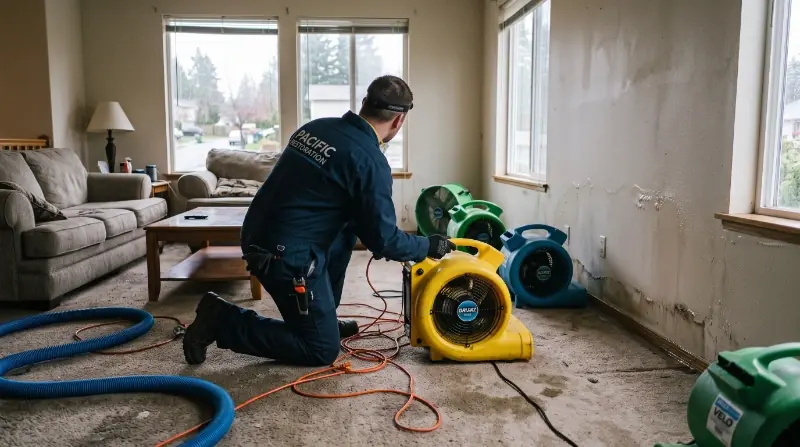
The work follows the IICRC S500 water damage standard: stop the source, remove water, measure moisture, dry with controlled airflow and dehumidification, then verify with readings before anything is closed up.
Inspect and classify
The crew identifies the water category (clean supply water is Category 1) and the class of the loss, which estimates how much material is wet and how hard it will be to dry.
Extract
Truck-mounted or portable extractors pull water from carpet, pad and hard floors. Water pulled out as liquid now is water the dehumidifiers won't need to evaporate and capture over the next several days.
Open what's trapped
Wet insulation comes out, baseboards come off, and a flood cut removes the bottom of soaked drywall so the cavity can breathe. Cabinets may get drilled for injection drying.
Dry and monitor
Air movers and LGR dehumidifiers run around the clock. Each day the technician records humidity, grains per pound, and readings from the wet materials.
Treat and close
An antimicrobial is applied where needed. Drywall goes back only after readings confirm the dry standard, which is the step that prevents mold behind new paint.
Because mold can start colonizing damp materials in 24 to 48 hours, the first visit matters more than any other. Each phase is explained in more detail in our six-phase restoration process.
Does living near Lake Washington or the Sammamish River change your claim?
Yes, because insurers separate water that escaped your plumbing from water that came in from outside. A burst pipe is usually covered; lake, river or surface flooding usually needs separate flood insurance.
Kenmore takes up the entire north shore of Lake Washington, and the Sammamish River runs through the middle of town, splitting it into north and south halves. The city's official elevation is just 39 feet. King County's watershed notes say that from Woodinville to the lake, the Sammamish "generally stays within its banks," helped by the Army Corps straightening the channel in 1966, and there are marshlands along Swamp Creek. So most burst pipe restoration Kenmore WA jobs start with a plumbing failure, not a river flood. Still, if you live in a low lot near the river or the lake and water appears after heavy rain, have the crew document the source carefully. Groundwater seepage is treated as Category 3 water and is generally not a burst pipe claim. The insurance help page covers how claims are split.
Kenmore water restoration for apartments, condos and manufactured homes
About 29.9% of Kenmore homes are in multi-unit buildings and 3.2% are mobile or manufactured homes, and both types fail differently than a detached house.
In a manufactured home, supply lines run through the underbelly, wrapped in insulation and a vapor barrier. When a line freezes and splits, water fills the belly wrap before anyone sees it inside, and the bottom board can sag with the weight. Crews have to open the belly, drain it, dry the insulation or replace it, and check the floor decking, which is often particleboard that swells and crumbles. Heat tape on exposed lines and skirting kept tight are the cheapest prevention.
In condos and apartments, one unit's failed dishwasher line can become three units' problem. Roughly 30.7% of Kenmore households rent. Tenants should notify the landlord in writing; under RCW 59.18.070, a landlord gets 24 hours to begin work if the unit loses water, heat or electricity, 72 hours if a supplied plumbing fixture such as the only toilet stops working, and 10 days for lesser defects. Condo owners should report to the HOA and their HO-6 carrier the same day. Our apartment burst pipe guide goes deeper.
Where does Kenmore's water come from, and where is your shutoff?
Northshore Utility District provides water and sewer service in Kenmore. It is a regional-supply partner of Seattle Public Utilities, so the water is the same soft mountain supply much of north King County drinks.
Your first shutoff is the one inside or right beside the house, usually a gate valve or quarter-turn ball valve where the line enters the foundation, in the garage, or in a crawlspace near the front. Many Kenmore houses also have a pressure reducing valve (PRV) near that main. A PRV that fails open can send full street pressure through the house and stress every fitting, so a sudden rise in pressure, banging pipes or a temperature-and-pressure relief valve that keeps dripping on the water heater is worth a plumber's look. The meter box near the street has a curb valve that usually needs a meter key. If the indoor valve will not close, call Northshore Utility District for help at the meter. If a sewer line backs up, treat it as Category 3 water and keep kids and pets out of the area.
What does burst pipe restoration in Kenmore cost?
Expect roughly $1,500–$4,000 for a small one-room loss, $5,000–$15,000 when several rooms need drywall removal, and from $15,000 up past $35,000 once subfloors, cabinets or multiple floors are involved.
Kenmore's median home value is about $920,800, and higher-end finishes such as site-finished hardwood, custom cabinetry and stone counters increase both drying effort and rebuild cost. Covered losses usually leave you with the deductible, commonly $1,000–$2,500. Emergency after-hours premiums may apply. For a ballpark before the adjuster arrives, use the burst pipe cost estimator.
Kenmore neighborhoods and landmarks we route calls for
Burst pipe restoration Kenmore WA calls come in from Inglewood, first platted in 1953; the Moorlands, where the first house went up in 1904; the hillside streets around Saint Edward State Park, a 365-acre park with more than half a mile of undeveloped lakeshore and the former seminary now operating as a hotel; and the waterfront near Kenmore Air Harbor and the Burke-Gilman Trail. The whole city shares the 98028 ZIP. Nearby, see Bothell burst pipe restoration upriver and burst pipe restoration in Shoreline to the west. The King County service area hub lists every city we cover.
Kenmore burst pipe repair and water restoration FAQs
I think my 1980s Kenmore house has polybutylene. How do I tell?
Polybutylene is usually gray, sometimes blue or black, and flexible, often stamped PB2110 on the side. Look where the supply line enters the house, at the water heater connections and under sinks. If you find it, have a plumber inspect the fittings, since those are where leaks start. Some insurers ask about polybutylene when you renew, so it is worth knowing before a claim.
My manufactured home in Kenmore had a frozen pipe under the floor. Can that be dried, or does the belly wrap have to come off?
In most cases the belly has to be opened at least partly. Water collects in the underbelly insulation and cannot dry through the plastic bottom board. The crew drains it, removes soaked insulation, dries the floor decking and checks for swelling. The plumber repairs the line. Then the belly is re-insulated and sealed. Heat tape on exposed lines helps prevent a repeat.
Does Northshore Utility District fix burst pipes inside my house?
No. The utility is responsible for the main and the meter, and the homeowner is responsible for the pipe from the meter into the house and everything inside. A leak between the main and the meter is Northshore Utility District's to fix. If it is on your side, call a licensed plumber and a restoration contractor. We can route the restoration side for you right away.
Water came into my lower level near the Sammamish River after a storm. Will my policy cover it as a burst pipe?
Probably not, if the water came from outside. Standard homeowners policies cover sudden and accidental plumbing discharges but exclude flood and surface water. Check whether your water meter is still moving with every fixture off. If it is still, the source is likely outside, and you would need flood coverage through NFIP or a private flood policy. The restoration crew can still dry the house either way.
How long will drying equipment run in a Kenmore home with hardwood floors?
Hardwood often adds days. A one-room loss on carpet over plywood might dry in three or four days, while site-finished oak can need a week or more with specialized floor drying mats. The goal is to bring the wood back near its normal moisture content without cupping. The technician should log readings daily and explain when each area reaches its target.
Related Pages
Water Coming Through in Kenmore Right Now?
Call (831) 230-143124 hours a day · Licensed, insured, IICRC-certified contractors · Insurance documentation from the first visit