Mold Prevention After a Burst Pipe in Kent, WA
Last updated: October 2026
Mold can begin in 24 to 48 hours per EPA guidance, and Kent’s climate supplies those conditions most of the year. The window to prevent it is short and it does not reopen.
Mold can begin growing in porous building materials within 24 to 48 hours after water exposure, per EPA guidance on indoor mold and moisture. Kent's Pacific Northwest climate provides favorable mold conditions most of the year. The window to prevent mold after a burst pipe is short. Every hour of standing water reduces the likelihood that materials can be dried in place rather than demolished and replaced. Fast response, thorough extraction, and IICRC S500 structural drying are the only way to prevent mold from establishing after a burst pipe.
How fast does mold start after a burst pipe in Kent?
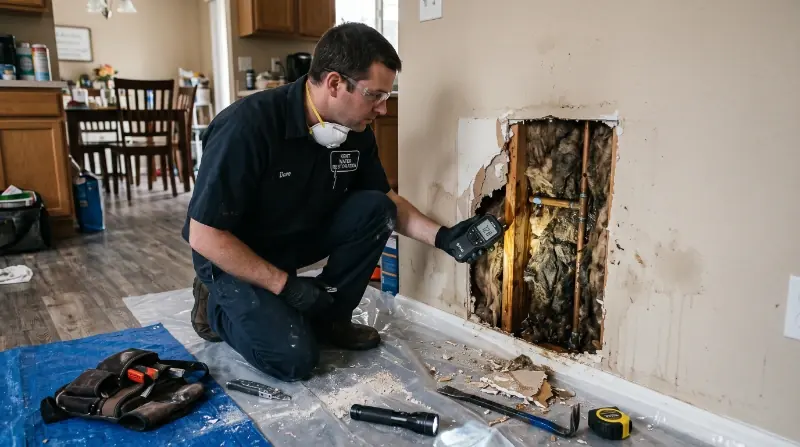
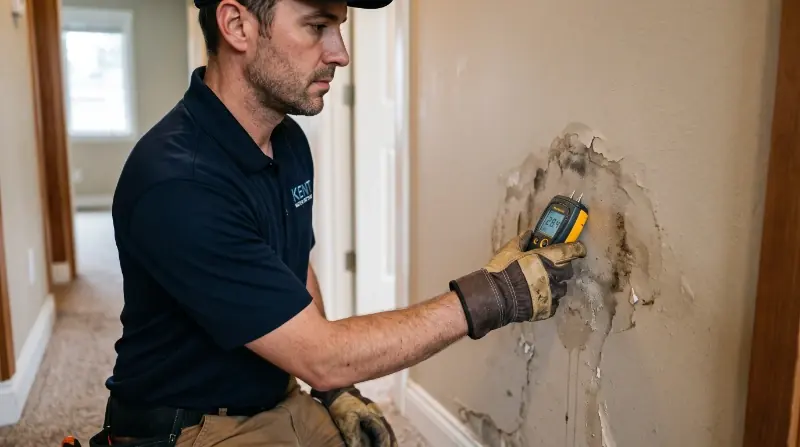
The EPA's guidance on indoor mold and moisture establishes that mold can begin growing in porous materials within 24 to 48 hours under favorable temperature and humidity conditions. Kent's climate provides those conditions. Unlike Phoenix or Denver, where lower humidity gives homeowners a longer window, Kent's Pacific Northwest moisture levels mean wet drywall, insulation, and wood framing are already close to the conditions mold spores need to germinate.
This is the real reason response time matters. A restoration company that arrives within 60 minutes versus one that arrives six hours later is not just a service difference. The difference can mean materials are saved versus demolished, and a three-day job versus a three-week mold remediation.
Hour-by-Hour After a Burst Pipe in Kent
How We Prevent Mold — The Four-Step Process
1. Thorough moisture mapping: We use thermal imaging and penetrating moisture meters to find all hidden water before setting any equipment. Mold cannot be prevented in locations that were not identified as wet.
2. Rapid extraction: All standing water removed before drying equipment is placed. This reduces the total moisture load the drying equipment must handle and accelerates the process.
3. Continuous commercial drying: LGR dehumidifiers and air movers run 24 hours a day. We do not turn equipment off overnight or reduce hours to cut costs. The drying cycle is continuous until dry standard is reached.
4. Calibrated dry standard verification: We confirm drying completion by calibrated moisture meter reading at or below pre-loss baseline, not by visual inspection or touch. Only then do we close walls. See our full process page for detailed steps.
Related Kent burst pipe pages
Burst pipe in Kent? Call before the 24-hour window closes
A contractor is on-site in 60 minutes. 24/7. All Kent ZIP codes.
(831) 230-1431 — Call NowWhy is the mold window shorter in the Pacific Northwest?
The EPA guidance that mold can begin growing within 24 to 48 hours under favorable conditions is written for average US conditions. In Kent, WA and the broader Pacific Northwest, the operative word is "favorable" — and favorable conditions exist for most of the year. Kent receives 44 to 50 inches of rain annually. Indoor relative humidity during the November-through-March wet season routinely runs 55 to 70% without dehumidification. Ambient temperatures stay between 45°F and 65°F year-round — the middle of the ideal mold growth range of 40°F to 100°F.
In practice, what this means is that the 24-to-48 hour window cited by the EPA compresses significantly in Kent homes during wet season. We have documented active mold growth in drywall paper as early as 18 hours after a supply line burst in homes with ambient humidity above 65%. Every hour that water sits in building materials in a Kent home from October through March is a hour in which mold conditions are met or exceeded.
What Mold Actually Needs — and What Burst Pipe Water Provides
Mold requires four things to grow: a food source, moisture, suitable temperature, and oxygen. Burst pipe water in a Kent home provides all four simultaneously:
Food source — Drywall paper, wood framing, OSB subfloor, carpet backing, and insulation all serve as mold food sources. Every common building material affected by a burst pipe provides adequate nutrition.
Moisture — Water content above 19% in wood or above 1% in drywall paper is sufficient for mold initiation. A burst pipe delivers water content of 40 to 80% in affected materials.
Temperature — Mold grows between 40°F and 100°F. Kent indoor temperatures year-round fall within this range.
Oxygen — Available everywhere. Cannot be removed as a control strategy in a living space.
The only variable in this equation that can be controlled is moisture. That is why IICRC S500 structural drying exists — and why the speed of both extraction and drying determines whether mold prevention succeeds or fails.
What We Do to Prevent Mold — Not Treat It
Mold prevention is the direct result of fast extraction and complete structural drying. There is no spray treatment or chemical application that prevents mold if materials remain above dry standard — those products address surface contamination, not the underlying moisture condition that drives growth. Our mold prevention protocol is:
Step 1 — Arrive within 60 minutes. Closing the gap between failure and extraction is the single highest-leverage action in mold prevention. Every minute of response time improvement is a minute of moisture contact time removed.
Step 2 — Extract completely. Truck-mounted extraction and submersible pumps remove standing and absorbed water to the extent physically possible before structural drying equipment is placed.
Step 3 — Map moisture migration. FLIR thermal imaging locates moisture that has migrated behind walls and under floors. Hidden wet areas are the primary mold risk — they are warm, dark, and wet, and they stay that way if not identified and dried.
Step 4 — Dry to S500 standard. LGR dehumidifiers and air movers run continuously until penetrating moisture meter readings return to pre-loss baseline. No wall is closed until dry standard is confirmed and logged.
Step 5 — Apply antimicrobial as secondary protection. After dry standard is confirmed, we apply an EPA-registered antimicrobial treatment to affected surfaces as a secondary barrier against residual spore activation. This is a supplement to complete drying, not a substitute for it.
What changes when mold has already started?
If a burst pipe loss was not addressed within the prevention window — typically 24 to 48 hours in Kent during wet season — active mold may already be present in affected materials. This changes the scope from water damage restoration to water damage restoration plus mold remediation, which follows IICRC S520 (Mold Remediation standard) rather than S500 alone.
Signs Mold May Already Be Present
Musty odor in affected area. Visible discoloration on drywall surface (black, green, or gray spots). Staining at the base of walls. Peeling paint or wallpaper. Soft or bubbling drywall surface. Any loss that has been wet for more than 48 hours in a Kent home during wet season.
What S520 Remediation Adds
Containment of the affected area with negative air pressure. HEPA air filtration running during demolition. Full personal protective equipment for technicians. Demolition of affected materials to a clean margin. Post-remediation clearance testing. Additional insurance documentation under a separate mold remediation scope.
Most homeowner policies cover mold remediation when it results from a sudden and accidental covered loss — meaning a burst pipe. Mold that developed from a long-term leak or unaddressed maintenance issue is typically excluded. We document the timeline from loss event to discovery to remediation to support your carrier's sudden-and-accidental classification.
Mold prevention questions
What related services and pages should I look at?
Burst Pipe in Kent Right Now?
Your call routes directly to a licensed local contractor. On-site in 60 minutes across all Kent ZIP codes.
(831) 230-14311819 Central Ave S, Kent, WA 98032 · Serving 98030 · 98031 · 98032 · 98042 · Work performed by licensed, insured, IICRC-certified contractors
Sources referenced on this page
- EPA — Mold cleanup in your home
- EPA — Brief guide to mold, moisture and your home
- IICRC S520 mold remediation standard
Last updated: October 20, 2026. Reviewed against the City of Kent Water Quality Report and IICRC S500 standard.