Commercial & Warehouse Burst Pipe Restoration in Kent Valley, WA
Last updated: October 20, 2026
Kent Valley is one of the largest warehouse and distribution districts in the Pacific Northwest, and its burst pipes are bigger: 2-inch mains, fire sprinkler lines, roof-drain leaders, and break-room supply lines in 100,000-square-foot buildings. Call (831) 230-1431 — the call routes to a licensed, IICRC-certified commercial restoration contractor with the extraction and drying capacity for large floor plates, 24/7.
Our Kent burst pipe restoration service handles commercial properties across the Kent Valley industrial corridor with the same 60-minute response target.
What bursts in a Kent warehouse or commercial building?
Four things, in rough order of frequency. Fire sprinkler lines: wet-pipe systems in unheated high-bay warehouses freeze at the branch lines nearest the dock doors, and a single head or fitting failure releases 20 to 40 gallons a minute until the riser is shut. Domestic supply mains: 1½- and 2-inch copper or galvanized feeding restrooms and break rooms, often original to 1970s–90s tilt-up construction and running above the ceiling grid of the office mezzanine. Roof drains: internal leaders that carry roof water down through the building crack at joints and dump onto racking during heavy rain. Water heaters and mop-sink supply lines: small pipes, but they run unnoticed over a weekend.
What makes commercial different from residential is not the pipe — it is what is underneath. A break-room line that fails on Friday night in a residential home floods a kitchen. The same line in a Kent Valley distribution centre floods a floor plate holding palletised inventory, and the loss is measured in product before it is measured in drywall.
What should a facilities manager do in the first 30 minutes?
Isolate the right system
Sprinkler failure: close the main control valve at the riser, notify the fire alarm monitoring company, and post a fire watch. Domestic failure: close the building main, usually at the backflow preventer near the meter vault. Do not close the sprinkler valve for a domestic leak or the reverse.
Cut power to the wet zone
Floor-level outlets, conveyor drives, and forklift chargers in standing water. Use the panel, not the equipment switches.
Move inventory before it wicks
Cardboard on a wet floor wicks 6 to 12 inches in an hour. Pallets on racking above floor level are usually fine; anything on the floor is moved to the dry side first.
Photograph and log
Time-stamped photos of the failure point, the water extent, and inventory positions before anything moves. Commercial adjusters ask for it.
Call (831) 230-1431
Say "commercial" and the building size. The contractor dispatches commercial-scale equipment and, for sprinkler failures, brings the licensed sprinkler contractor into the same response.
How is a large floor plate dried without shutting the building?
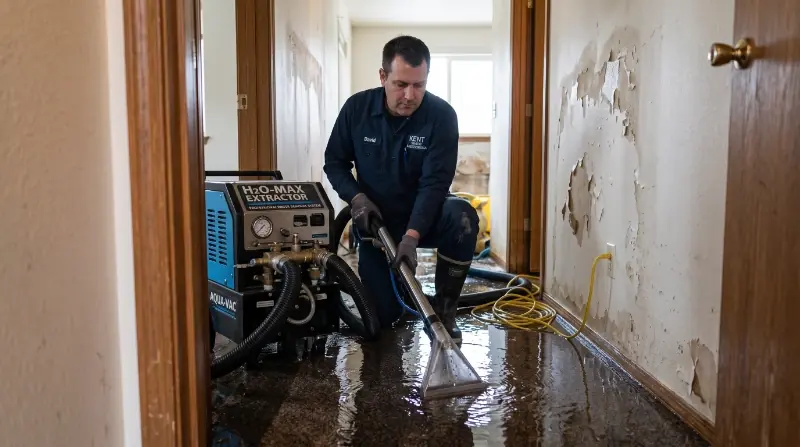
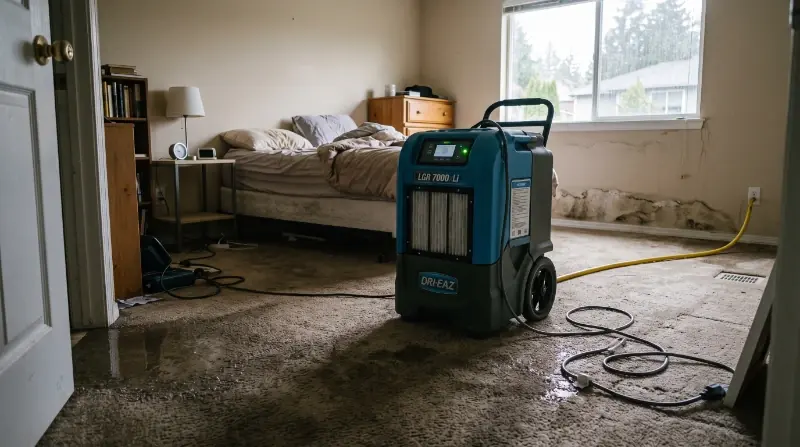
Containment first. The contractor sets poly containment walls around the wet zone so the drying equipment works on a defined air volume instead of a 30-foot-clear-height warehouse. Extraction on sealed concrete is fast — most of the water is gone in hours. The scope that takes time is the office build-out: drywall partitions, carpet tile, ceiling grid, and insulated exterior walls, which are dried with LGR dehumidifiers and air movers on the same three-to-five-day cycle as residential work. For high-bay spaces where the roof deck or insulation got wet, desiccant dehumidifiers are used because they keep working in the cold air of an unheated warehouse where refrigerant units stall.
Operations continue on the dry side. Equipment runs on a dedicated circuit or a generator so it does not trip the building's load, and drying is phased so the receiving dock, for example, is back in service before the office mezzanine. Daily moisture logs go to the property manager and the adjuster.
What does commercial burst pipe restoration cost in Kent Valley?
| Scenario | Typical Kent range | Who pays |
|---|---|---|
| Break-room or restroom line, office area under 2,000 sq ft | $4,000 – $12,000 | Commercial property policy |
| Domestic main failure, office build-out 2,000–8,000 sq ft | $12,000 – $40,000 | Commercial property policy |
| Sprinkler branch failure over warehouse floor, inventory affected | $15,000 – $60,000+ | Building + business personal property |
| Roof drain leader failure over racking | $8,000 – $30,000 | Commercial property policy |
| Sprinkler system repair (licensed sprinkler contractor) | $1,500 – $8,000 | Owner / policy varies |
| Business interruption during shutdown | Varies | BI coverage if carried |
Kent, WA commercial ranges via the WA Restore Pro contractor network, 2025–2026. Commercial Xactimate scope and inventory log provided.
Which Kent commercial districts are covered?
The Kent Valley industrial corridor — West Valley Highway, 84th Avenue S, S 212th and S 228th Streets, and the Kent Station and downtown office district in ZIP 98032. Also the retail and medical-office clusters on East Hill along 104th Avenue SE and Kent-Kangley Road. Multi-family and landlord-owned property is covered on the landlord page.
Note for Kent Valley property managers: the same Green River floodplain that raises the water table under valley homes sits under the warehouse district, and a Howard Hanson Dam release can put groundwater into a below-grade loading pit or elevator shaft with no pipe failure at all. That is a flood-policy event, not a property-policy event; the contractor documents the cause separately.
Frequently asked questions
How fast can a contractor respond to a burst pipe in a Kent Valley warehouse?
The same 60-minute target as residential, 24 hours a day, with commercial-scale equipment: truck-mounted extractors rated for large floor plates, multiple LGR dehumidifiers, and desiccant units for high-bay spaces. Kent Valley's industrial corridor along West Valley Highway, 84th Ave S, and S 212th St is inside the primary response zone.
Does commercial property insurance cover a burst pipe in a Kent warehouse?
Yes. A sudden pipe or sprinkler line failure is covered under standard commercial property policies for the building damage; business personal property and inventory are covered if scheduled; and business interruption pays lost income during the shutdown if you carry it. The contractor prepares a commercial Xactimate scope and a separate inventory-damage log.
Who handles a fire sprinkler pipe failure — a plumber or a sprinkler contractor?
A licensed fire sprinkler contractor must repair the sprinkler system itself under Washington fire code, and the fire marshal may need to inspect before the building reoccupies. The water damage restoration is handled by the restoration contractor, and the two are coordinated through one call.
Can we keep operating during restoration?
Usually part of the building can. The contractor sets containment around the affected zone, runs equipment on a separate circuit or generator, and phases drying so the dry side of the warehouse stays in use. Racking and inventory in the wet zone are moved out first; concrete floors dry fast, so the shutdown is often measured in days rather than weeks.
Burst pipe or sprinkler failure in a Kent commercial building?
Your call routes directly to a licensed, IICRC-certified Kent contractor — same-day, 60-minute response across 98030, 98031, 98032 and 98042. Free estimate before any work begins.
(831) 230-1431Sources referenced on this page
- Washington L&I contractor verification
- Washington OIC — commercial property claims
- King County Flood Control District — Lower Green River
- IICRC S500
Last updated: October 20, 2026. Reviewed against the City of Kent Water Quality Report and IICRC S500 standard.