Slab Leak in Kent, WA — Finding It, Fixing It, and Restoring the Floor
Last updated: October 20, 2026
A slab leak is a supply pipe leaking under the concrete floor of a slab-on-grade home — common in Kent Valley, rare on the hills. Signs are a warm floor spot, a creeping meter, and cupped flooring with no source above. Call (831) 230-1431: a licensed Kent contractor confirms the leak, coordinates a leak-detection plumber, and restores the floor and walls the water reached, with the damage and slab access billed to your insurer.
Our Kent burst pipe restoration service handles the water damage portion of a slab leak while your plumber addresses the pipe repair or reroute.
Why do Kent Valley homes get slab leaks and hill homes don't?
Because of what the house sits on. Most of Kent's post-1955 valley-floor homes and nearly all of its commercial buildings were poured slab-on-grade, with copper supply lines laid in or under the slab before the concrete went down. East Hill, West Hill, Scenic Hill, and Panther Lake homes were framed over crawlspaces, so their pipes hang under the floor where they can be seen and reached. A hill-home pipe that leaks drips into a crawlspace. A valley-home pipe that leaks soaks the soil under the slab, and the first sign is on the floor above.
Kent Valley soil makes it worse. The Green River floodplain keeps the ground under those slabs damp year-round, and damp soil against bare copper pits it from the outside. Add the hot-water line — which expands and contracts with every shower and rubs against the concrete at the same spot for forty years — and the hot side fails first in nearly every Kent slab leak the contractors see.

How is a slab leak found without tearing up the floor?
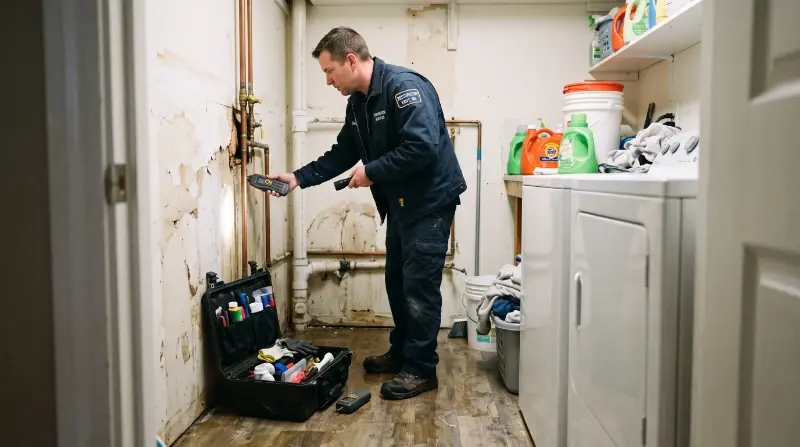
In three steps, none of which break concrete. First, the meter test: every fixture off, and the low-flow indicator on the meter still turns. Second, isolation: the hot and cold sides are valved off one at a time at the water heater to learn which line leaks. Third, location: a leak-detection plumber pressurises the suspect line with air or nitrogen and listens for it with acoustic equipment, or traces it with a thermal camera when it is a hot line. Location is usually accurate to a couple of feet, so the slab is opened at one spot, not along the whole run.
This is a two-trade job, like every page on this site: a licensed plumber finds and fixes the pipe; the restoration contractor handles the water damage and, when the slab is opened, the cutting, spoil removal, re-pour, and floor replacement. WA Restore Pro routes your call to the restoration contractor, who brings the leak-detection plumber into the same visit.
Repair through the slab or reroute overhead?
Repairing through the slab means cutting a 2×2-foot square of concrete, digging to the pipe, cutting in a coupling, and re-pouring. It is the right call for a first leak in otherwise sound pipe at an accessible spot. Rerouting means abandoning the under-slab line and running new PEX overhead through the attic or walls to the fixtures it served. It is the right call when the copper is old, when there has been a previous slab leak, or when the leak sits under a kitchen island or bathroom where opening the slab means removing cabinets or a tub. In Kent Valley homes built before 1980, the contractors' default recommendation is a hot-side reroute.
| Scenario | Typical Kent range | Who pays |
|---|---|---|
| Leak detection (plumber) | $250 – $500 | Homeowner |
| Direct repair through slab incl. re-pour | $2,000 – $4,500 | Slab access often insurer; pipe repair homeowner |
| Reroute one line overhead in PEX | $1,500 – $3,500 | Homeowner |
| Reroute entire hot side | $4,000 – $8,000 | Homeowner |
| Water damage restoration — flooring, drywall, cabinets | $2,500 – $9,000 | Insurer, minus deductible |
| Mold remediation if leak ran for weeks | + $3,000 – $8,000 | Often disputed as long-term seepage |
Kent, WA ranges via the WA Restore Pro contractor network, 2025–2026. Check your policy for slab-access limits before work starts.
What does the water damage from a slab leak look like?
Different from a burst pipe. There is rarely standing water; instead the slab wicks moisture upward into whatever sits on it. Laminate and engineered wood swell and cup. Tile grout darkens and tiles lift. Carpet pad stays damp and smells in a week. Drywall pulls moisture up from the bottom plate, so the stain starts at the baseboard and climbs. Because it is slow, mold is the main risk — by the time a Kent Valley homeowner notices the warm spot, the bottom plate has often been wet for a month. The restoration scope typically includes removing the flooring in the affected area, drying the slab and the bottom of the walls, and treating the plate before new flooring goes down.
Frequently asked questions
How do I know I have a slab leak in my Kent home?
The classic signs are a warm spot on the floor (hot-line leak), a water meter that creeps with every tap off, a water bill that jumped, the sound of running water with nothing on, and damp or cupped flooring with no source above it. Kent Valley slab-on-grade homes get them most; hill homes on crawlspaces almost never do.
Does insurance cover a slab leak in Kent, WA?
Partly. Washington homeowner policies generally cover the water damage a slab leak causes — flooring, drywall, cabinets — and the cost of tearing out and replacing the slab to reach the pipe ("access"), minus the deductible. They do not cover the pipe repair itself, and most exclude the leak if it has clearly been running for months. Check your policy for a slab-leak or access exclusion; a few carriers cap it.
How much does slab leak repair and restoration cost in Kent?
Detection $250 to $500. A direct repair through the slab, including jackhammering and re-pouring, $2,000 to $4,500. Rerouting the line overhead through walls to avoid the slab, $1,500 to $3,500. Water damage restoration on top of that, $2,500 to $9,000 depending on flooring. Many Kent homeowners with one slab leak reroute the whole hot side, $4,000 to $8,000, rather than open the slab twice.
Should I repair the slab leak or reroute the pipe?
Reroute if the home has had more than one slab leak or the copper is over 35 years old — the rest of the run is in the same condition. Repair through the slab if it is the first leak, the pipe is otherwise sound, and the location is accessible. Rerouting avoids breaking the slab at all and is usually faster.
Warm spot on the floor or creeping meter in Kent?
Your call routes directly to a licensed, IICRC-certified Kent contractor — same-day, 60-minute response across 98030, 98031, 98032 and 98042. Free estimate before any work begins.
(831) 230-1431Sources referenced on this page
- Washington OIC — leaks, water damage and mold coverage
- City of Kent Water Quality Report
- Washington L&I contractor verification
- IICRC S500
Last updated: October 20, 2026. Reviewed against the City of Kent Water Quality Report and IICRC S500 standard.